





What Makes a High-Quality Embryo Transfer Catheter? A Practical Guide for IVF Professionals
Embryo transfer is widely recognized as one of the most delicate steps in an IVF cycle. By the time this procedure takes place, significant effort has already gone into ovarian stimulation, egg retrieval, fertilization, embryo culture, and embryo selection. The final objective is clear: place the embryo gently and accurately inside the uterine cavity under the best possible conditions.
Although embryo quality and endometrial receptivity remain major contributors to IVF success, the embryo transfer procedure itself should never be underestimated. A smooth, atraumatic transfer allows clinicians to complete the procedure with confidence while minimizing unnecessary manipulation of the cervix and uterus.
As discussed in our previous article, **Why Embryo Transfer Technique Still Matters in IVF**, even small improvements in embryo transfer technique can contribute to a more controlled clinical procedure. Choosing the right embryo transfer catheter is an important part of that process.
However, not every embryo transfer catheter offers the same level of performance. While many catheters may appear similar at first glance, differences in design, materials, flexibility, ultrasound visibility, and manufacturing quality can significantly influence the overall clinical experience.
So, what exactly defines a high-quality embryo transfer catheter?
In this article, we explore the characteristics that fertility specialists should consider when evaluating embryo transfer catheters and explain why quality involves much more than simply choosing a well-known brand.
A high-quality embryo transfer catheter is designed to support smooth navigation, accurate embryo placement, and consistent handling throughout the embryo transfer procedure.
—
Why Catheter Quality Matters in Modern IVF
Choosing a high-quality embryo transfer catheter has become an important consideration for IVF clinics seeking greater procedural consistency and clinician confidence.
Modern IVF clinics are continually looking for ways to improve consistency, efficiency, and patient care. While advances in embryology and laboratory technologies have received considerable attention over the past decade, the instruments used during embryo transfer have also evolved significantly.
An embryo transfer catheter is far more than a simple tube designed to carry an embryo into the uterus. It serves as the clinician’s interface during one of the most critical moments of the IVF procedure. Every aspect of its design—from the softness of the tip to its flexibility and visibility under ultrasound—can influence how comfortably and accurately the transfer is performed.
The objective is not simply to complete the procedure. The goal is to perform embryo transfer with minimal cervical manipulation, precise catheter placement, and maximum procedural confidence.
A high-quality catheter can help clinicians navigate different anatomical situations more smoothly while reducing unnecessary resistance during insertion. Better handling characteristics may also improve procedural consistency, particularly in clinics performing a high volume of embryo transfers.
It is equally important to remember that catheter quality alone does not determine IVF success. Embryo quality, laboratory performance, endometrial receptivity, physician experience, and patient-related factors all contribute to clinical outcomes.
Instead, a well-designed embryo transfer catheter should be viewed as a tool that supports experienced clinicians in carrying out a controlled, atraumatic, and patient-centered procedure.
This perspective reflects the growing emphasis on quality improvement in assisted reproductive technology, where every stage of the IVF journey is carefully optimized.
—
What Defines a High-Quality Embryo Transfer Catheter?
When evaluating an embryo transfer catheter, it is easy to focus on a single feature, such as flexibility or ultrasound visibility. In reality, catheter performance depends on a combination of carefully balanced characteristics rather than one individual property.
The highest-quality embryo transfer catheters are designed to provide predictable handling, gentle navigation, and reliable embryo delivery while adapting to the wide variety of anatomical situations encountered in daily IVF practice.
Several key characteristics should always be considered.
Ultimately, a high-quality embryo transfer catheter combines multiple design features into a single device that supports safe, predictable, and patient-centered embryo transfer.
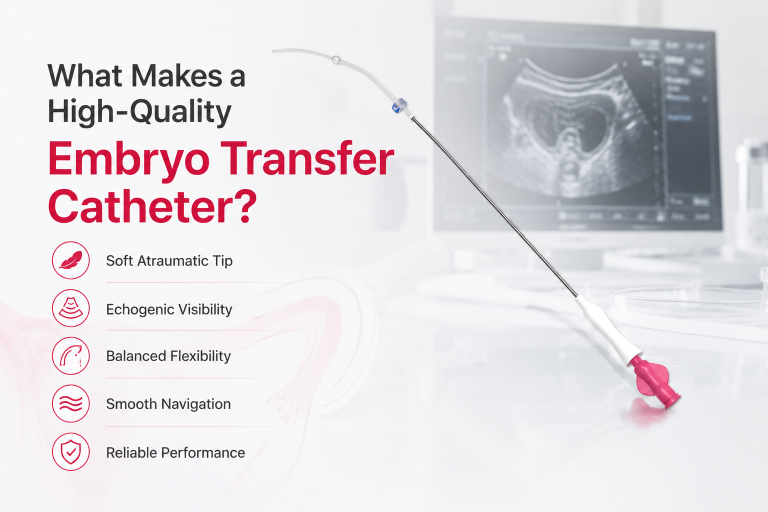
1-Soft, Atraumatic Tip
The catheter tip is the first component to enter the cervical canal and uterine cavity. Its design plays a crucial role in minimizing tissue irritation during insertion.
A soft, atraumatic tip helps reduce unnecessary contact with the endometrium and lowers the risk of bleeding or provoking uterine contractions. At the same time, the tip must retain enough structural integrity to allow precise embryo placement without compromising procedural control.
Finding the right balance between softness and stability is one of the defining characteristics of a well-designed embryo transfer catheter.
2-Excellent Ultrasound Visibility
Ultrasound-guided embryo transfer has become standard practice in many fertility clinics around the world. For this reason, catheter visibility has become an increasingly important consideration.
An echogenic embryo transfer catheter allows clinicians to identify the catheter tip more clearly during ultrasound guidance, improving confidence during catheter positioning before embryo deposition.
As discussed in our previous article, **Why Echogenic Embryo Transfer Catheters Are Becoming Essential for Ultrasound-Guided IVF Procedures**, enhanced visualization supports procedural accuracy while helping reduce unnecessary catheter repositioning during transfer.
3-Balanced Flexibility and Support
One of the most important qualities of an embryo transfer catheter is achieving the right balance between flexibility and support.
A catheter that is excessively flexible may bend when resistance is encountered, making advancement more difficult. Conversely, a catheter that is too rigid may increase patient discomfort and reduce the ability to navigate natural cervical anatomy smoothly.
The ideal catheter combines sufficient flexibility to follow the cervical canal with enough shaft support to maintain precise clinician control throughout the procedure.
4-Smooth Inner Lumen
The internal lumen of the catheter receives far less attention than the external design, yet it plays an essential role in embryo transfer.
A smooth, highly polished inner lumen minimizes friction during embryo loading and transfer while supporting predictable movement of the transfer medium. Consistency throughout the internal channel helps ensure reliable embryo delivery and reduces unnecessary mechanical stress.
5-Minimal Embryo Retention
One of the goals of modern catheter design is to minimize the possibility of embryos remaining inside the catheter after transfer.
Advanced materials, optimized internal geometry, and precise manufacturing processes all contribute to reducing embryo retention and supporting complete embryo deposition within the uterine cavity.
6-Ergonomic Handling
Finally, handling characteristics should never be overlooked.
An embryo transfer catheter should provide clinicians with comfortable tactile feedback, intuitive control, and predictable performance throughout the procedure. Easy handling not only improves procedural efficiency but also helps clinicians maintain confidence when managing both routine and more challenging embryo transfers.
Why One Feature Alone Is Never Enough
When evaluating an embryo transfer catheter, it can be tempting to focus on a single characteristic. Some clinics prioritize ultrasound visibility, while others place greater emphasis on catheter flexibility or handling.
In reality, no single feature defines the overall quality of an embryo transfer catheter.
For example, a catheter with excellent echogenicity may provide outstanding visibility during ultrasound-guided procedures, but if it lacks the right balance of flexibility and support, navigating certain cervical anatomies may become more challenging.
Likewise, an extremely soft catheter may reduce tissue irritation, yet excessive flexibility could make controlled advancement more difficult in patients with a tortuous cervical canal.
This is why modern embryo transfer catheter design is based on achieving balance rather than maximizing one individual property.
Each feature should complement the others.
A well-designed catheter combines atraumatic insertion, reliable ultrasound visibility, appropriate shaft support, smooth internal flow characteristics, and comfortable handling into a single device that supports clinicians throughout the procedure.
As discussed in our previous article, **How to Choose the Right Embryo Transfer Catheter for Successful IVF Procedures**, selecting a catheter should always take into account the patient’s anatomy, the clinician’s technique, and the specific requirements of the IVF clinic rather than relying on one technical specification alone.
Ultimately, quality is determined by how all these characteristics work together during real clinical practice.
—
Choosing Quality Means Choosing Consistency
Consistency is one of the most valuable qualities in modern reproductive medicine.
IVF professionals perform embryo transfer hundreds—or even thousands—of times throughout their careers. Every procedure should offer the same level of confidence, predictability, and control.
This is why manufacturing quality is just as important as catheter design.
Even the most innovative catheter concept cannot deliver reliable clinical performance if production standards vary between batches.
High-quality embryo transfer catheters are manufactured using carefully controlled materials, validated production processes, and strict quality control procedures. Sterility, dimensional accuracy, packaging integrity, and product consistency all contribute to dependable clinical performance.
For fertility clinics, consistency means clinicians can trust that each catheter will perform in the same predictable manner every time it is used.
This reliability becomes particularly important in busy IVF centers where procedural efficiency and standardized clinical protocols help optimize workflow.
Quality should also extend beyond the device itself.
Reliable technical documentation, regulatory compliance, responsive customer support, and consistent product availability all play an important role when selecting a long-term supplier for IVF consumables.
Rather than asking only, *”Is this catheter well designed?”*, clinics should also consider:
– Is the manufacturing process consistent?
– Does the supplier maintain recognized quality standards?
– Can the product be supplied reliably over time?
– Will clinicians receive the same handling characteristics with every catheter?
These questions become increasingly important as IVF clinics seek to standardize procedures while maintaining high levels of patient care.
—
Different Patients, Different Clinical Needs
No two IVF patients are exactly alike.
Differences in cervical anatomy, uterine position, previous cervical procedures, and overall procedural complexity mean that clinicians frequently encounter varying clinical situations during embryo transfer.
For this reason, there is no universal embryo transfer catheter that performs perfectly in every case.
Instead, clinicians should select a catheter that best matches the patient’s anatomy and the procedural requirements of each transfer.
This individualized approach reflects one of the core principles of modern reproductive medicine: adapting the procedure to the patient whenever possible.
Clinics that recognize these differences are better positioned to perform embryo transfer with confidence while minimizing unnecessary cervical manipulation.
—
Looking Beyond Product Specifications
Evaluating a high-quality embryo transfer catheter requires looking beyond technical specifications and considering real-world clinical performance.
Technical specifications are important—but they do not tell the whole story.
Catalogs often describe catheter diameter, shaft length, flexibility, or ultrasound visibility. While these details are valuable, they cannot fully describe how a catheter performs during a real embryo transfer.
Clinical experience, ease of handling, tactile feedback, and procedural confidence are equally important.
An embryo transfer catheter should support the clinician rather than become another challenge during the procedure.
As highlighted in our article **What Causes Difficult Embryo Transfer? Clinical Challenges and Practical Solutions**, difficult embryo transfer is rarely caused by one factor alone. Patient anatomy, procedural planning, physician experience, and catheter characteristics all interact to influence the overall clinical experience.
Evaluating a catheter therefore requires looking beyond technical specifications and considering how the device performs in everyday IVF practice.
The best catheter is not necessarily the one with the longest feature list—it is the one that consistently supports safe, gentle, and predictable embryo transfer across a wide range of clinical situations.
—
Conclusion
A high-quality embryo transfer catheter is not defined by one feature alone but by the combination of design, reliability, and consistent clinical performance.
A high-quality embryo transfer catheter is more than a medical device—it is an important part of one of the most delicate procedures in assisted reproductive technology.
From atraumatic tip design and excellent ultrasound visibility to balanced flexibility, smooth handling, and consistent manufacturing quality, every design element contributes to supporting a controlled embryo transfer procedure.
At the same time, catheter selection should always be viewed within the broader context of IVF treatment. Embryo quality, laboratory excellence, physician experience, and patient-specific factors remain fundamental to clinical success.
By understanding what truly defines a high-quality embryo transfer catheter, fertility clinics can make better-informed decisions that support procedural consistency, clinician confidence, and patient-centered care.
As IVF technology continues to evolve, thoughtful device selection will remain an essential part of delivering safe, efficient, and high-quality reproductive care.