





Follicle Flushing in IVF: When Is It Needed and Which OPU Needle Design Supports It?
During ovum pick-up (OPU), the primary objective is to retrieve mature oocytes by aspirating follicular fluid under continuous ultrasound guidance. In many IVF procedures, aspiration alone is sufficient to collect the oocyte. However, in selected clinical situations, some fertility specialists may also perform follicle flushing.
Follicle flushing in IVF involves introducing a small volume of flushing medium into the follicle after the initial aspiration and then re-aspirating the fluid in an attempt to recover any remaining oocyte. Although this technique has been used in assisted reproduction for many years, its routine use remains a topic of clinical discussion.
Whether follicle flushing should be performed depends on physician preference, patient characteristics, and the IVF clinic’s protocol. As a result, selecting an OPU Needle that supports the intended clinical workflow is an important consideration when planning egg retrieval procedures.
This article explains what follicle flushing in IVF is, when it may be considered, the current evidence surrounding its use, and how different OPU Needle hub designs support this technique.
What Is Follicle Flushing in IVF?
Follicle flushing in IVF is an additional step that may be performed during egg retrieval after the initial aspiration of a follicle. Instead of relying solely on the first aspiration, the physician introduces sterile flushing medium into the follicle and then aspirates the fluid again in an attempt to retrieve the oocyte.
The technique is most commonly discussed in relation to selected clinical scenarios, such as patients with a limited number of follicles or when the physician believes additional aspiration may be appropriate. However, its application varies considerably between IVF centers, and many clinics continue to achieve excellent outcomes using aspiration alone.
It is important to distinguish follicle flushing from routine follicular aspiration. Aspiration is the standard method used during every egg retrieval procedure, whereas follicle flushing is an optional technique incorporated into specific clinical protocols.
For a broader understanding of egg retrieval instruments and their role in assisted reproduction, you may also read our article, **What Is an OPU Needle? A Complete Guide to Ovum Pick-Up Needles in IVF.**
Why Do Some IVF Clinics Perform Follicle Flushing?
Follicle Flushing in IVF is a technique that some IVF clinics may use during oocyte retrieval procedures with the aim of improving the recovery process in selected cases. During a standard egg retrieval procedure, an aspiration needle is used to collect follicular fluid containing the oocyte. In follicle flushing, after the initial aspiration, a compatible flushing solution may be introduced into the follicle and then aspirated again.
The main reason some clinicians consider follicle flushing In IVF is the possibility of recovering additional oocytes that may not have been collected during the first aspiration attempt. This approach is based on the idea that repeated aspiration and flushing of the follicular cavity may help retrieve remaining follicular contents.
However, the decision to perform follicle flushing depends on several factors, including the clinic’s protocol, the physician’s experience, the patient’s ovarian response, and the characteristics of the follicles being retrieved. It is not routinely performed in all IVF centers, as many clinics achieve satisfactory oocyte retrieval results using standard aspiration techniques alone.
From a technical perspective, the choice of an appropriate OPU Needle can also influence the efficiency and consistency of the retrieval procedure. Needle design features such as tip configuration, echogenic visibility, hub design, and handling characteristics may support controlled aspiration during oocyte collection. However, the needle itself does not determine whether follicle flushing should be performed; this remains a clinical decision based on the overall treatment situation.
As with many techniques used in assisted reproductive technology, follicle flushing continues to be discussed among IVF professionals. Differences in clinical protocols and patient characteristics mean that results may vary between studies and treatment centers.
Selecting the appropriate OPU Needle is an important consideration in oocyte retrieval procedures. Factors such as needle handling, visibility, and compatibility with clinical protocols can influence the workflow. Learn more about selecting the right needle for IVF procedures in our guide: How to Choose the Right OPU Needle for Safe and Efficient Egg Retrieval.
Does Follicle Flushing Improve Egg Retrieval Outcomes?
The effectiveness of follicle flushing in improving egg retrieval outcomes remains a topic of discussion in reproductive medicine. While some studies have investigated whether follicle flushing can increase the number of retrieved oocytes, the overall evidence has not established a universal benefit for all IVF patients.
Several factors influence IVF success, including ovarian stimulation protocols, egg quality, sperm parameters, laboratory conditions, embryo culture techniques, and the expertise of the clinical team. Therefore, evaluating follicle flushing only by the number of retrieved oocytes may not provide a complete picture of its clinical value.
Current evidence suggests that follicle flushing In IVF should be considered as one of the available approaches in oocyte retrieval rather than a guaranteed method for improving IVF results. Decisions regarding its use are generally based on the physician’s assessment, laboratory protocols, and the specific needs of each patient.
For IVF clinics, maintaining consistent retrieval techniques and using reliable equipment, including well-designed OPU Needle systems, remains an important part of achieving controlled and reproducible procedures. A carefully selected needle design can support smooth aspiration and handling during retrieval, while clinical judgment remains the key factor in choosing whether additional techniques such as follicle flushing are appropriate.
Further clinical research may help clarify which patient groups could benefit most from follicle flushing and how it should be integrated into modern oocyte retrieval protocols.
Which OPU Needle Designs Support Follicle Flushing?
The design of an OPU Needle can influence how smoothly aspiration and flushing steps are performed during oocyte retrieval procedures. Since follicle flushing involves repeated cycles of fluid introduction and aspiration, the connection system and handling characteristics of the needle may be important considerations for IVF professionals.
Different OPU Needle hub designs provide different levels of flexibility during clinical use. Traditional needle configurations are commonly used for standard follicular aspiration, while designs that allow easier control of fluid pathways may be considered when a clinic’s protocol includes follicle flushing.
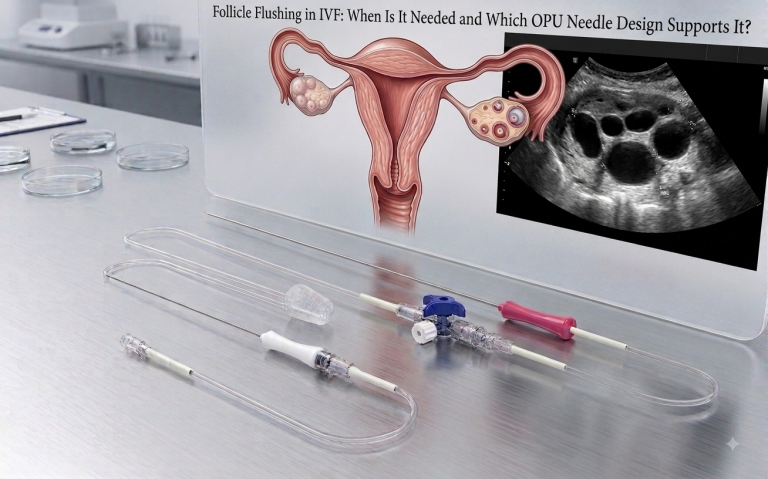
A Luer-Lock (LL) hub design provides a secure connection between the needle and compatible syringes or tubing systems. This type of connection helps maintain stability during aspiration procedures and reduces the risk of accidental disconnection during handling.
A 3-Way Stopcock (3W) design provides an additional control point that allows the operator to manage the direction of fluid flow. In procedures where repeated aspiration and flushing steps are performed, this type of configuration may offer more flexibility by allowing controlled switching between different fluid pathways.
Beyond hub configuration, other design characteristics such as needle tip performance, echogenic visibility, and material quality can influence the usability of an OPU Needle during retrieval procedures. To understand the key characteristics of a reliable retrieval needle, explore: What Makes a High-Quality OPU Needle? Key Design Features That Matter in IVF.
However, the choice of OPU Needle design depends on the clinical workflow, physician preference, and the specific requirements of the IVF laboratory. Needle design alone does not determine retrieval success, but an appropriate configuration can support a more controlled and efficient procedure.
When selecting an OPU Needle for follicle flushing applications, IVF clinics generally consider factors such as connection type, ease of handling, compatibility with existing equipment, and consistency during repeated aspiration steps.
Luer-Lock (LL) vs 3-Way Stopcock (3W): What’s the Difference?
Luer-Lock (LL) and 3-Way Stopcock (3W) represent two different hub configurations used in OPU Needle systems. The main difference between these designs is the level of fluid pathway control available during the procedure.
A Luer-Lock hub uses a threaded connection mechanism that securely attaches the needle to a syringe or compatible component. This design is widely used because of its simple structure, reliable connection, and familiarity among healthcare professionals.
A 3-Way Stopcock hub includes a valve mechanism that allows the operator to control fluid flow between multiple ports. In follicle flushing procedures, this configuration may provide additional convenience when alternating between aspiration and flushing steps without repeatedly disconnecting equipment.
The choice between these two designs is usually based on the clinic’s established protocol and the preferences of the medical team. Some IVF professionals may prefer the simplicity of a Luer-Lock system, while others may value the additional flow control offered by a 3-Way Stopcock configuration.
Both designs can be suitable for oocyte retrieval procedures when used according to appropriate clinical protocols. The most suitable option depends on factors such as workflow requirements, equipment compatibility, and operator experience.
| Feature | Luer-Lock (LL) | 3-Way Stopcock (3W) |
|---|---|---|
| Connection type | Secure threaded connection | Multi-port valve system |
| Fluid control | Requires connection changes for different pathways | Allows controlled switching between pathways |
| Common consideration | Simplicity and reliability | Flexibility during repeated fluid handling |
| Suitable for | Standard aspiration workflows | Protocols requiring additional flow control |
OPU Needle hub design can affect how clinicians manage connections and fluid pathways during retrieval procedures. To compare Classic, Luer-Lock, and 3-Way Stopcock configurations in more detail, read our dedicated article: Understanding OPU Needle Hub Designs: Classic, Luer-Lock, and 3-Way Stopcock.
How to Choose the Right OPU Needle for Follicle Flushing
Choosing an appropriate OPU Needle for Follicle Flushing in IVF requires consideration of both the clinical procedure and the practical needs of the IVF team. There is no single needle configuration that is suitable for every clinic, and selection should be based on validated protocols and professional experience.
Important factors to consider include:
Hub Design and Fluid Control
The hub configuration is one of the main differences between OPU Needle models. Clinics performing follicle flushing may evaluate whether a Luer-Lock or 3-Way Stopcock design better matches their workflow and preferred handling method.
Needle Compatibility and Handling
The needle should be compatible with the clinic’s aspiration system and allow comfortable handling during ultrasound-guided retrieval. Smooth operation and consistent control are important factors during repeated aspiration procedures.
Visibility and Procedural Control
Clear visualization of the needle tip under ultrasound guidance can support accurate follicle access. Needle characteristics such as echogenic properties may be considered when selecting an OPU Needle for retrieval procedures.
Clinical Protocol Requirements
The choice of needle should always be aligned with the clinic’s established retrieval protocol. Factors such as patient characteristics, physician preference, and laboratory workflow may influence the final decision.
A suitable OPU Needle should support the clinical team’s technique while maintaining consistent performance throughout the procedure.
Frequently Asked Questions
Does Follicle Flushing in IVF require a special OPU Needle?
Not necessarily. Follicle flushing protocols may use different OPU Needle configurations depending on the clinic’s procedure and equipment setup. Some clinics may prefer designs that provide additional fluid control, such as a 3-Way Stopcock system.
Is a 3-Way Stopcock OPU Needle better than a Luer-Lock needle?
Neither design can be considered universally better. A 3-Way Stopcock may provide additional control over fluid pathways, while a Luer-Lock design offers a simple and secure connection. The most appropriate choice depends on the clinical workflow and physician preference.
Does Follicle Flushing in IVF always increase the number of retrieved eggs?
No. Current evidence does not support the idea that follicle flushing consistently improves egg retrieval outcomes for all patients. Its potential value may depend on individual clinical circumstances.
Can OPU Needle design affect IVF success?
OPU Needle design can influence procedural handling and workflow, but IVF outcomes depend on many factors, including ovarian response, laboratory conditions, embryo quality, and clinical protocols.
What should IVF clinics consider when selecting an OPU Needle?
Clinics should consider factors such as hub design, compatibility, handling characteristics, ultrasound visibility, and alignment with their established retrieval procedures.
Conclusion
Follicle Flushing in IVF is a technique used by some IVF clinics as part of oocyte retrieval protocols, particularly in situations where additional follicular aspiration steps may be considered. While research continues to evaluate its potential impact on retrieval outcomes, current evidence does not indicate that follicle flushing provides a guaranteed improvement for every patient.
The design of an OPU Needle can play an important role in supporting the practical aspects of follicular aspiration and flushing procedures. Features such as Luer-Lock and 3-Way Stopcock hub configurations provide different approaches to connection and fluid management, allowing clinics to select a design that fits their workflow.
As assisted reproductive technology continues to evolve, ongoing research and clinical experience will further define the role of techniques such as follicle flushing in modern IVF practice.