





Does More Eggs Retrieved Mean a Better Chance of Pregnancy in IVF?
When you are going through IVF, it is easy to focus on one number: how many eggs were retrieved.
You may hear that a higher number of eggs gives you a better chance of success. But is that really true?
The short answer is: more eggs can increase the chances of having embryos available for transfer, but more eggs do not automatically mean a higher chance of pregnancy or a live birth.
The number of eggs retrieved is only one part of the IVF journey. Egg maturity, egg quality, fertilization, embryo development, maternal age, sperm factors and the quality of the embryos available for transfer all matter.
In this article, we explain what the number of eggs retrieved really means and why fertility specialists and embryologists look beyond the egg count when assessing an IVF cycle.
Does More Eggs Retrieved Mean a Better Chance of Pregnancy?
Generally, retrieving more eggs can provide more opportunities to obtain mature eggs, fertilize them and develop embryos.
However, the relationship is not as simple as:
More eggs = higher pregnancy rate.
Research has found an association between the number of eggs retrieved and IVF outcomes, but the benefit does not continue indefinitely. A large systematic review and meta-analysis reviewed more than one million patients and found that live birth rates increased with the number of eggs retrieved up to a point, then reached a plateau, with some analyses showing a decline at very high egg numbers.
This is why fertility specialists do not simply try to obtain the highest possible number of eggs.
The goal is to achieve an appropriate ovarian response while maintaining patient safety and obtaining a useful number of mature eggs.
Why Does the Number of Eggs Retrieved Matter?
An IVF cycle involves several steps between egg retrieval and pregnancy.
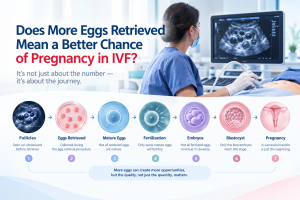
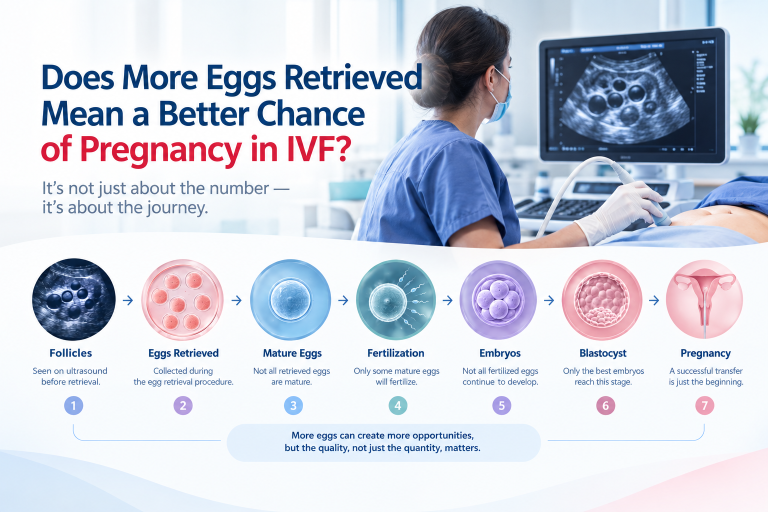
A simplified journey looks like this:
Follicles → Retrieved eggs → Mature eggs → Fertilized eggs → Embryos → Blastocysts → Embryo transfer → Pregnancy
At every step, some eggs or embryos may be lost.
For example, a patient may have several follicles visible on ultrasound, but not every follicle will produce a retrieved egg.
Then, not every retrieved egg will be mature.
Among mature eggs, not all will fertilize.
And among the fertilized eggs, not all will continue developing into embryos suitable for transfer or freezing.
This is why the number of eggs retrieved is important—but it is only the beginning of the process.
What Happens to the Eggs After Egg Retrieval?
After egg retrieval, the embryology team examines the eggs and determines their maturity and suitability for further treatment.
The next steps may include:
- Identifying the retrieved oocytes
- Assessing their maturity
- Fertilizing suitable mature eggs
- Monitoring fertilization
- Culturing embryos in the laboratory
- Assessing embryo development
- Transferring or freezing suitable embryos
This means that a cycle with 15 retrieved eggs does not necessarily result in 15 embryos.
Likewise, a cycle with fewer eggs can still result in a good-quality embryo and a successful pregnancy.
Related reading
[What Is an OPU Needle? A Complete Guide to Ovum Pick-Up Needles in IVF]
This article explains the egg retrieval procedure and the role of the OPU needle in collecting oocytes from ovarian follicles.
[How to Choose the Right OPU Needle for Safe and Efficient Egg Retrieval]
Learn more about the factors that can influence the egg retrieval procedure and OPU needle selection.
More Eggs Does Not Always Mean More Embryos
One of the most important things for IVF patients to understand is that there is a natural drop-off between each stage of treatment.
Imagine that 12 eggs are retrieved.
The actual outcome might look something like:
12 retrieved eggs → 9 mature eggs → 7 fertilized eggs → 4 developing embryos → 1–2 suitable blastocysts
These numbers are only an example. Actual results can be very different from one patient to another.
This is why comparing your egg count with another patient’s egg count can be misleading.
A person who retrieved 20 eggs does not necessarily have a better chance of pregnancy than someone who retrieved 8 eggs.
The final outcome depends on what happens to those eggs and embryos throughout the IVF process.
Egg Quantity vs. Egg Quality: Which Is More Important?
This is one of the most common questions patients ask.
The answer is that both matter, but they represent different things.
Egg quantity refers to how many eggs are available.
Egg quality refers to the developmental potential of an egg and, after fertilization, its ability to contribute to a healthy embryo.
Importantly, ovarian reserve and egg quality are not the same thing. The American Society for Reproductive Medicine (ASRM) notes that ovarian reserve primarily reflects the quantity of remaining oocytes, while reproductive aging and other factors have a stronger relationship with reproductive potential.
In practical terms, having a large number of eggs does not necessarily mean that all of those eggs have the same developmental potential.
Does Age Affect the Meaning of Egg Count?
Yes.
Age is one of the most important factors when interpreting IVF outcomes.
The number of eggs retrieved can provide useful information about ovarian response, but egg quantity should not be considered separately from age and other clinical factors.
For example, two patients may both have 10 eggs retrieved, but their expected outcomes may be different because of differences in age, ovarian reserve, egg quality and other reproductive factors.
This is one reason fertility specialists avoid using a single egg-count number to predict the outcome of an IVF cycle.
What Does the Embryologist Look At?
From the patient’s perspective, the retrieval number may be the first result they hear.
From the embryologist’s perspective, the picture is much more detailed.
The embryology team may evaluate:
- How many eggs were retrieved
- How many are mature
- Whether fertilization occurred
- How the embryos develop
- Whether embryos reach the blastocyst stage
- Embryo morphology and other laboratory findings
- Which embryos may be suitable for transfer or cryopreservation
This helps explain why the number of eggs retrieved is not the final measure of IVF success.
The Embryologist’s Perspective
A useful question is not simply:
“How many eggs did we retrieve?”
but:
“How many eggs became usable embryos?”
The answer to that question gives the IVF team more information about what happened during the cycle.
Is There a “Good” Number of Eggs to Retrieve?
There is no single number that is ideal for every patient.
A patient’s expected response depends on factors such as:
- Age
- Ovarian reserve
- AMH and antral follicle count
- Previous response to ovarian stimulation
- Stimulation protocol
- Individual ovarian response
- Underlying fertility factors
Research has explored whether there is an optimal number of retrieved oocytes. One large meta-analysis found that live birth rates after fresh embryo transfer generally increased as the number of retrieved oocytes increased, but the benefit reached a plateau rather than increasing indefinitely.
Therefore, the goal of IVF treatment is not simply to maximize the number of eggs.
It is to achieve an appropriate response for the individual patient while minimizing treatment risks and maximizing the opportunity to obtain useful embryos.
What If Only a Few Eggs Were Retrieved?
A low egg count can understandably be disappointing.
But a lower number does not mean that pregnancy is impossible.
ASRM notes that ovarian reserve markers such as AMH and AFC are useful for predicting ovarian response and oocyte yield, but they are not strong independent predictors of reproductive potential.
In some patients, a smaller number of eggs may still produce a good-quality embryo.
The important question is not simply how many eggs were retrieved, but what happened to those eggs afterward.
Your fertility specialist may consider:
- Your age
- Previous IVF response
- Ovarian reserve
- Number of mature eggs
- Fertilization results
- Embryo development
- Previous treatment outcomes
before deciding whether any changes are appropriate for a future cycle.
What If Many Eggs Were Retrieved?
A high egg yield may provide more opportunities to obtain embryos, but a very high response is not necessarily the goal.
Ovarian stimulation must also be balanced against patient safety.
One concern associated with a high ovarian response is ovarian hyperstimulation syndrome (OHSS). The ESHRE ovarian stimulation guideline specifically addresses the prevention of OHSS and emphasizes individualized ovarian stimulation and safety.
This is another reason why “more” should not automatically be interpreted as “better.”
A fertility specialist aims for an appropriate response rather than simply maximizing egg numbers.
Can the Egg Retrieval Procedure Affect the Number of Eggs Retrieved?
The number of follicles seen during ultrasound and the number of eggs actually retrieved are not always identical.
Several factors can influence the final retrieval result.
The egg retrieval procedure involves carefully accessing ovarian follicles and aspirating their contents. The OPU needle is an important part of this procedure, but the outcome also depends on ovarian response, follicle characteristics, timing of the trigger, the retrieval technique and other clinical factors.
For a patient-friendly explanation of the procedure, see:
[What Is an OPU Needle? A Complete Guide to Ovum Pick-Up Needles in IVF]
You can also read:
[What Makes a High-Quality OPU Needle? Key Design Features That Matter in IVF]
These articles explain the procedure and the design considerations behind OPU needles without reducing IVF success to a single device or number.
What Matters More Than the Egg Count?
When fertility specialists assess an IVF cycle, they usually consider the entire chain of events.
Important factors can include:
1. Patient age
Age is a major factor in reproductive outcomes and is particularly important when interpreting egg quality and embryo development.
2. Ovarian response
The number of follicles and eggs retrieved provides information about how the ovaries responded to stimulation.
3. Egg maturity
Not every retrieved egg is necessarily mature and ready for fertilization.
4. Fertilization
The number of eggs that successfully fertilize is another important step.
5. Embryo development
The ability of fertilized eggs to continue developing is critical.
6. Embryo quality
Ultimately, the embryos available for transfer or freezing are much closer to the final goal than the initial egg count.
7. Embryo transfer
Even when a good-quality embryo is available, implantation and pregnancy depend on additional factors.
For more information, see:
[What Happens on Embryo Transfer Day? A Step-by-Step IVF Guide]
and
[What Happens After Embryo Transfer? Understanding the Two-Week Wait]
A Simple Way to Think About IVF Egg Numbers
Instead of thinking:
“I need as many eggs as possible.”
it may be more helpful to think:
“I need an appropriate number of healthy, mature eggs that give me a reasonable opportunity to develop embryos.”
That is a much more realistic way to understand IVF.
The ultimate goal is not to collect the largest possible number of eggs.
The goal is to give the patient the best reasonable opportunity to obtain an embryo capable of resulting in a healthy pregnancy.
Questions to Ask Your Fertility Specialist After Egg Retrieval
If you have recently undergone egg retrieval, consider asking your fertility team:
- How many eggs were retrieved?
- How many were mature?
- How many fertilized?
- How are the embryos developing?
- How many embryos reached the blastocyst stage?
- Are there embryos available for transfer or freezing?
- How does this cycle compare with my previous cycles?
- Does my egg yield suggest an appropriate ovarian response?
- Is there anything important to consider before another IVF cycle?
These questions can provide much more useful information than simply knowing the total number of eggs retrieved.
The Bottom Line: Is More Eggs Always Better in IVF?
No.
A higher number of retrieved eggs can increase the pool of eggs available for fertilization and may increase the opportunity to obtain embryos.
However, more eggs do not automatically mean a higher chance of pregnancy.
The number of eggs retrieved is only one part of the IVF process. Egg maturity, egg quality, fertilization, embryo development, patient age, embryo quality and the individual circumstances of each patient all contribute to the final outcome.
The most meaningful question is therefore not:
“How many eggs did I get?”
but:
“What happened to those eggs, and how many healthy embryos did they produce?”
That is where the expertise of both the fertility specialist and embryology team becomes especially important.