


Understanding OPU Needle Hub Designs: Classic, Luer-Lock, and 3-Way Stopcock
Every detail of an OPU Needle can influence the efficiency of egg retrieval, and one of the most important design elements is the hub configuration.
While the needle shaft is responsible for follicle puncture and aspiration, the hub determines how the device connects to the aspiration system, how clinicians handle the needle, and whether additional functions such as follicle flushing can be performed efficiently.
Today, IVF clinics can choose from several OPU Needle hub designs, each developed to support different clinical preferences and procedural workflows.
This article explains the differences between Classic (CL), Luer-Lock (LL), and 3-Way Stopcock (3W) hub designs, helping fertility specialists, embryologists, purchasing teams, and distributors better understand when each configuration may be most appropriate.
Why Hub Design Matters During Ovum Pick-Up
During ovum pick-up (OPU), physicians perform multiple follicular aspirations under continuous ultrasound guidance. Throughout the procedure, the needle must remain stable, easy to control, and securely connected to the aspiration system.
Although the hub does not directly affect needle sharpness or ultrasound visibility, it plays an important role in workflow efficiency. A well-designed hub can improve handling, simplify fluid management, and support different aspiration techniques depending on the clinic’s protocol.
Understanding these differences allows IVF teams to select an OPU Needle that matches both physician preference and clinical requirements.
If you are evaluating the overall characteristics of an OPU Needle, you may also find our guide on What Makes a High-Quality OPU Needle? Key Design Features That Matter in IVF helpful.
Classic (CL) OPU Needle: Simple and Reliable
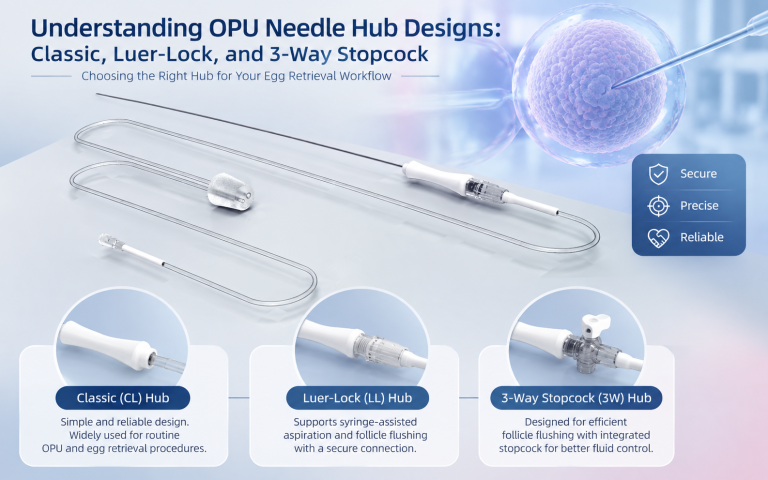
The Classic (CL) hub is one of the most widely recognized OPU Needle configurations used in IVF procedures. Its straightforward design provides a secure connection to the aspiration tubing while allowing physicians to perform follicular aspiration with minimal complexity.
Many IVF clinics appreciate the Classic hub because it offers a familiar handling experience and integrates easily into established egg retrieval protocols. Its uncomplicated design can also simplify preparation before the procedure, making it a practical choice for routine ovum pick-up.
The Classic configuration is particularly suitable for clinics that perform standard aspiration procedures without the need for additional flushing mechanisms. When combined with a high-quality needle tip and reliable aspiration system, the Classic hub supports smooth and consistent follicular fluid collection.
Although simple in appearance, the overall performance of a Classic OPU Needle still depends on manufacturing precision, ergonomic design, and compatibility with the clinic’s aspiration equipment.
Luer-Lock (LL) OPU Needle: Supporting Syringe-Assisted Aspiration and Follicle Flushing
The Luer-Lock (LL) hub incorporates a threaded connector that enables a secure attachment between the OPU Needle and a compatible syringe. This configuration provides additional flexibility for IVF teams that prefer syringe-assisted aspiration or occasional follicle flushing during egg retrieval.
Because the Luer-Lock connection minimizes the risk of accidental disconnection, it offers a stable interface whenever manual syringe attachment is required. Depending on the physician’s technique and the clinic’s protocol, this design can support greater procedural flexibility while maintaining reliable fluid control.
IVF clinics may select the Luer-Lock configuration when aspiration techniques require manual syringe connection or when follicle flushing is performed as part of selected clinical cases. The choice ultimately depends on physician preference, clinical workflow, and established laboratory protocols.
As with any OPU Needle, the overall clinical experience is influenced not only by the hub configuration but also by the quality of the needle tip, ultrasound visibility, manufacturing consistency, and ergonomic handling.
3-Way Stopcock (3W): Designed for Efficient Follicle Flushing
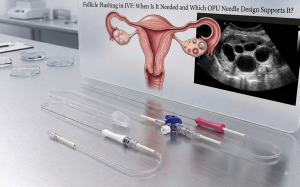
The 3-Way Stopcock (3W) hub is designed for IVF clinics that incorporate follicle flushing into their egg retrieval workflow. By integrating a three-way stopcock directly into the hub, clinicians can manage aspiration and flushing through a single connected system without repeatedly disconnecting tubing or accessories.
This integrated design can improve procedural efficiency by simplifying fluid management during selected egg retrieval techniques. The ability to switch between aspiration and flushing through the stopcock may also help maintain a more organized workflow, particularly during procedures involving multiple follicles.
Whether follicle flushing is routinely performed depends on the physician’s clinical judgment and the specific IVF protocol followed by the clinic. For this reason, the 3-Way Stopcock configuration is often selected based on procedural preference rather than as a universal requirement.
When evaluating this hub design, IVF clinics should consider factors such as ease of handling, secure connections, reliable fluid control, and compatibility with their existing aspiration systems to ensure efficient performance throughout the procedure.
Comparing CL, LL, and 3W Hub Designs
Each OPU Needle hub design serves the same primary purpose—supporting safe and efficient follicular aspiration during egg retrieval. The differences lie in how each configuration integrates with the clinical workflow and accommodates physician preferences.
The Classic (CL) hub offers a straightforward solution for routine aspiration procedures and is often preferred for its simplicity and ease of use.
The Luer-Lock (LL) hub adds flexibility by providing a secure threaded connection for syringe-assisted aspiration and, when required, follicle flushing. This configuration can be valuable for clinics that prefer greater versatility during selected procedures.
The 3-Way Stopcock (3W) hub is designed for workflows that include follicle flushing. Its integrated stopcock allows clinicians to manage aspiration and flushing through a single connected system, reducing the need to disconnect and reconnect components during the procedure.
Rather than asking which hub design is “best,” IVF clinics should determine which configuration best matches their clinical protocols, physician preferences, and aspiration techniques.
How to Choose the Right Hub Design for Your IVF Workflow
Selecting the most appropriate hub design begins with understanding how egg retrieval procedures are routinely performed in your IVF clinic.
Questions that may help guide the decision include:
• Is standard follicular aspiration sufficient for most procedures?
• Does your clinical protocol include follicle flushing in selected cases?
• Do physicians prefer syringe-assisted aspiration?
• Which hub configuration integrates most efficiently with your aspiration system?
• Is ease of handling an important consideration for your clinical team?
There is no single hub design that is ideal for every IVF clinic. The best choice is the one that supports a consistent workflow, meets clinical requirements, and aligns with physician experience.
If you are still comparing complete OPU Needle characteristics, you may also find our article “How to Choose the Right OPU Needle for Safe and Efficient Egg Retrieval” helpful.
Frequently Asked Questions
What is the difference between Classic, Luer-Lock, and 3-Way Stopcock OPU Needles?
The primary difference is the hub configuration. Each design supports different handling preferences and clinical workflows while serving the same overall purpose of follicular aspiration during egg retrieval.
Which hub design is best for every IVF clinic?
There is no universal answer. The most appropriate hub depends on physician preference, aspiration technique, and the clinic’s established IVF protocol.
When is a Luer-Lock hub preferred?
A Luer-Lock hub may be selected when syringe-assisted aspiration or occasional follicle flushing is part of the clinical workflow.
What is the advantage of a 3-Way Stopcock hub?
The integrated stopcock allows clinicians to manage aspiration and follicle flushing through a single connected system, supporting efficient fluid management during selected procedures.
Does hub design affect embryo quality?
No. Embryo quality depends on many biological and laboratory factors. The hub design primarily influences device handling, fluid management, and procedural workflow during egg retrieval.
Conclusion
Although every OPU Needle is designed to support follicular aspiration, the hub configuration can influence how efficiently the procedure fits into an IVF clinic’s workflow.
Classic (CL), Luer-Lock (LL), and 3-Way Stopcock (3W) hub designs each offer distinct advantages depending on physician preferences, aspiration techniques, and whether follicle flushing is incorporated into the clinical protocol.
By understanding the characteristics of each hub configuration, fertility specialists, embryologists, purchasing teams, and distributors can make more informed decisions when selecting an OPU Needle for their clinical practice.
If you would like a broader introduction to OPU Needles and their role in IVF, you can also read our article “What Is an OPU Needle? A Complete Guide to Ovum Pick-Up Needles in IVF.“
For readers interested in understanding the engineering and performance characteristics of these devices, our article “What Makes a High-Quality OPU Needle? Key Design Features That Matter in IVF” provides a detailed overview of the features that contribute to reliable clinical performance.