





Why Embryo Transfer Technique Still Matters in IVF: How Catheter Design Influences Clinical Outcomes
Over the past two decades, assisted reproductive technology (ART) has advanced dramatically. Improvements in ovarian stimulation protocols, time-lapse embryo culture systems, blastocyst selection, genetic testing, and cryopreservation have all contributed to higher success rates in in vitro fertilization (IVF).
Yet despite these innovations, embryo transfer technique remains one of the most critical—and often underestimated—determinants of IVF success.
Even when high-quality embryos are available, a technically difficult embryo transfer can negatively affect implantation and clinical pregnancy rates. Unlike embryo quality, maternal age, or ovarian reserve, embryo transfer technique is a factor that clinicians can directly optimize through careful planning, appropriate equipment selection, and standardized procedural protocols.
Several studies have reported that difficult embryo transfers may reduce pregnancy rates by as much as 30% compared with smooth, atraumatic procedures. This makes embryo transfer technique one of the few modifiable variables capable of improving IVF outcomes without altering laboratory conditions.
Why Embryo Transfer Technique Matters
Embryo transfer is the final step in the IVF process, but it is also one of the most delicate.
The objective is straightforward: place the embryo gently into the optimal area of the uterine cavity while causing minimal cervical or endometrial trauma.
However, this procedure is influenced by numerous factors, including:
- Patient anatomy
- Cervical accessibility
- Uterine position
- Catheter characteristics
- Operator experience
- Ultrasound visualization
Even a perfectly developed embryo may fail to implant if transfer is traumatic or technically difficult.
For this reason, many reproductive specialists consider embryo transfer to be one of the most operator-dependent procedures in reproductive medicine.
What Makes an Embryo Transfer Difficult?
A difficult embryo transfer can occur for various anatomical and clinical reasons.
The most common causes include:
- Cervical stenosis, often following LEEP or cervical conization
- Marked anteflexion or retroflexion of the uterus
- Acute cervical-uterine angles
- Excess cervical mucus obstructing catheter passage
- Submucosal fibroids
- Endometrial polyps
- Previous cervical surgery
- Cervical scarring from prior difficult embryo transfers
- Increased cervical tone
- Congenital uterine anomalies
These situations frequently require multiple catheter passes or cervical manipulation, increasing the likelihood of bleeding, uterine contractions, and embryo displacement.
Proper pre-procedure assessment can help clinicians anticipate these challenges and select the most suitable transfer strategy.
Common Mistakes That Can Reduce IVF Success
Even experienced clinicians may encounter technical issues that negatively influence implantation.
Common procedural mistakes include:
- Touching the uterine fundus with the catheter tip
- Repeated catheter insertion attempts
- Using an inappropriate catheter for difficult anatomy
- Excessive manipulation of the cervix
- Poor ultrasound visualization
- Inconsistent embryo loading techniques
- Delayed embryo deposition after catheter loading
- Blood or mucus contamination of the catheter tip
Many of these factors are preventable through standardized protocols and proper catheter selection.
How Catheter Design Influences Embryo Transfer Technique
Modern embryo transfer catheters have evolved significantly to address procedural challenges while minimizing trauma.
Several design characteristics have been associated with improved procedural performance.
Soft Atraumatic Tip
Soft catheter tips reduce friction against the endometrium and minimize bleeding.
Less trauma may reduce uterine contractions and create a more favorable environment for implantation.
Pre-Curved Catheter Design
Catheters with a pre-formed curvature (typically 15°–45°) better accommodate difficult cervical anatomy and uterine flexion.
This feature can reduce the need for cervical traction and facilitate smoother catheter advancement.
Echogenic Tip Technology
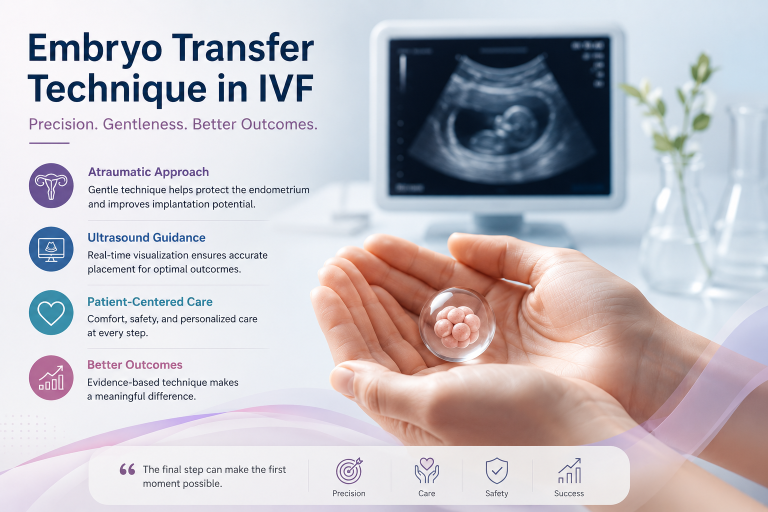
Ultrasound-guided embryo transfer has become the preferred standard in many IVF centers.
Echogenic catheter tips improve visualization during the procedure, enabling clinicians to position embryos accurately approximately 1–2 cm below the uterine fundus.
Improved visualization also reduces unnecessary catheter manipulation.
Ultrasound guidance has become standard practice in many IVF centers, and catheter visibility plays an important role in procedural accuracy. Learn more about how echogenic embryo transfer catheters improve real-time ultrasound guidance in our detailed article.
Dual-Sheath System
Many modern embryo transfer systems combine:
- A supportive outer sheath for navigation
- A soft inner catheter for embryo deposition
This combination provides stability while minimizing endometrial trauma during the final transfer.
Precise Dead Space Calibration
Embryo loading requires a carefully controlled air-fluid-embryo-fluid-air sequence.
Accurate catheter calibration helps maintain consistent loading volumes and reproducible embryo placement.
How to Choose the Right Embryo Transfer Catheter
There is no universal catheter suitable for every patient.
Catheter selection should be individualized based on cervical anatomy, uterine position, and procedural complexity.
General considerations include:
Routine embryo transfers
- Soft catheter
- Flexible tip
- Ultrasound visibility
Difficult cervical anatomy
- Pre-curved catheter
- Dual-sheath system
- Greater navigational support
Severe uterine flexion
- Catheters designed for challenging anatomical angles
Selecting the appropriate device before beginning the procedure often reduces manipulation and procedural time.
What Does the Clinical Evidence Show?
Clinical evidence consistently supports the importance of embryo transfer technique.
A Cochrane systematic review demonstrated higher clinical pregnancy rates with soft embryo transfer catheters compared with firm catheters.
Additional studies have shown that ultrasound-guided embryo transfer improves implantation rates compared with the clinical touch technique.
Research also suggests that minimizing cervical trauma and reducing uterine contractions contribute to improved implantation potential.
Although embryo quality remains the primary predictor of success, optimizing embryo transfer technique can significantly improve outcomes, particularly in patients with anatomically difficult transfers.
Practical Recommendations for IVF Clinicians
To optimize embryo transfer outcomes, clinicians should consider the following evidence-based practices:
- Perform a mock embryo transfer when difficult anatomy is suspected.
- Evaluate cervical anatomy before the procedure.
- Select the catheter according to patient anatomy rather than using one catheter for every case.
- Use ultrasound guidance whenever possible.
- Choose echogenic catheter tips for better visualization.
- Minimize catheter passes.
- Avoid touching the uterine fundus.
- Standardize embryo loading protocols.
- Ensure close communication between the embryology laboratory and the transfer physician.
- Review difficult transfer cases regularly as part of quality improvement programs.
Conclusion
While advances in embryo culture, cryopreservation, and embryo selection continue to improve IVF success rates, embryo transfer technique remains one of the most influential—and controllable—steps in the treatment process.
Atraumatic transfer, careful procedural planning, and the appropriate selection of embryo transfer catheters can reduce technical difficulty and improve implantation outcomes.
Modern catheter technologies—including soft atraumatic tips, echogenic visualization, pre-curved designs, and dual-sheath systems—provide clinicians with practical tools to overcome anatomical challenges while protecting the endometrium.
Ultimately, successful IVF depends not only on embryo quality but also on delivering that embryo precisely, gently, and consistently. By refining embryo transfer technique and selecting the right catheter for each clinical scenario, IVF teams can further optimize pregnancy outcomes and enhance the overall quality of patient care.