





Why Choosing the Right Embryo Transfer Catheter Matters
Embryo transfer is often described as the final step of an IVF cycle, but in reality, it is one of the most delicate moments in the entire treatment process. After weeks of ovarian stimulation, egg retrieval, fertilization, and embryo culture, the success of the procedure ultimately depends on placing the embryo gently and accurately inside the uterus.
While embryo quality and endometrial receptivity remain essential factors for implantation, the embryo transfer procedure itself should never be underestimated. Even a high-quality embryo may face unnecessary challenges if the transfer is technically difficult or if excessive manipulation occurs during the procedure.
This is where the embryo transfer catheter plays a critical role.
Although it may appear to be a simple medical device, an embryo transfer catheter is specifically designed to help clinicians navigate the cervical canal smoothly and deliver the embryo with minimal trauma to the uterine environment. Its flexibility, visibility under ultrasound, and overall handling characteristics can all influence how comfortably and confidently the procedure is performed.
Over the past decade, IVF specialists have placed increasing emphasis on optimizing embryo transfer techniques. In our previous article, Why Embryo Transfer Technique Still Matters in IVF, we explored how careful catheter handling, gentle embryo deposition, and minimizing uterine manipulation remain fundamental principles of a successful embryo transfer.
At the same time, advances in catheter technology have introduced new features that improve procedural confidence. One of the most important developments is echogenic technology, which enhances catheter visibility during ultrasound-guided embryo transfer. As discussed in our article, Why Echogenic Embryo Transfer Catheters Are Becoming Essential for Ultrasound-Guided IVF Procedures, improved visualization helps clinicians identify the catheter tip more accurately during the procedure.
However, choosing the right embryo transfer catheter involves more than selecting the newest product or following personal preference. Every patient presents unique anatomical characteristics, and every IVF clinic has its own procedural workflow. Understanding which catheter features truly matter allows clinicians to make more informed decisions while helping fertility clinics deliver safe, consistent, and patient-centered care.
In the following sections, we’ll explore the key characteristics of a high-quality embryo transfer catheter and explain what IVF professionals should consider before making their choice.
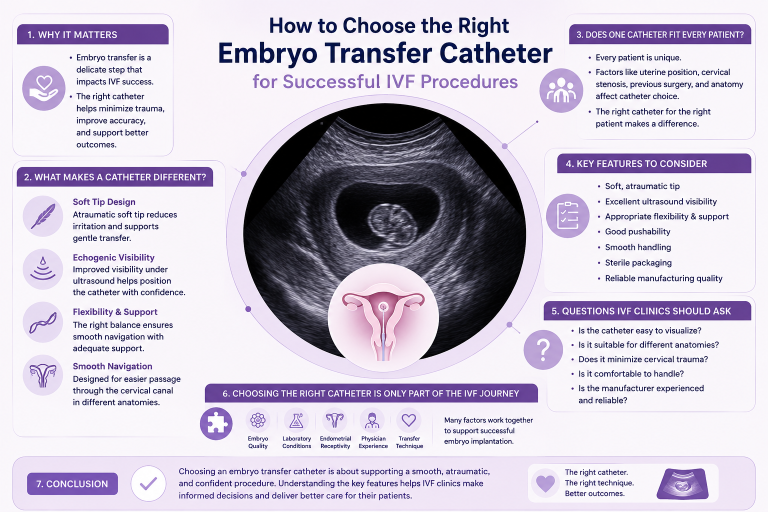
What Makes an Embryo Transfer Catheter Different?
At first glance, most embryo transfer catheters appear remarkably similar. They are all designed to deliver an embryo into the uterine cavity, and their overall shape may look almost identical.
However, experienced IVF professionals know that the differences are often found in the details.
A well-designed embryo transfer catheter is more than a simple delivery device. It is engineered to help clinicians perform embryo transfer smoothly, minimize unnecessary cervical manipulation, and maintain precise control throughout the procedure.
Several key characteristics distinguish one catheter from another.
1-Soft Tip Design
The tip of the catheter is the first part to pass through the cervical canal and enter the uterine cavity. For this reason, softness is one of the most important design considerations.
A soft, atraumatic tip helps reduce irritation of the endometrium and lowers the likelihood of causing bleeding or unnecessary uterine contractions during embryo transfer.
At the same time, the tip must remain stable enough to allow accurate embryo placement. Finding the right balance between flexibility and control is an essential part of catheter design.
2-Echogenic Visibility
Modern IVF procedures are increasingly performed under ultrasound guidance. While ultrasound improves procedural accuracy, it also requires the catheter tip to be clearly visible during the transfer.
This is where echogenic technology becomes valuable.
Special surface treatments or echogenic markings improve the visibility of the distal catheter under ultrasound, allowing clinicians to monitor catheter advancement in real time and position the tip with greater confidence before embryo deposition.
3-Flexibility and Pushability
An embryo transfer catheter must be flexible enough to follow the natural curvature of the cervical canal while remaining sufficiently supportive to advance smoothly without bending or buckling.
If the catheter is too soft, it may collapse when resistance is encountered. On the other hand, an excessively rigid catheter may increase patient discomfort and make atraumatic transfer more difficult.
For this reason, manufacturers carefully balance flexibility and shaft support to provide predictable handling during a wide variety of clinical situations.
4-Smooth Navigation Through the Cervical Canal
Every patient’s anatomy is unique. Some embryo transfers are completed effortlessly, while others may involve cervical narrowing, uterine flexion, or anatomical variations that require greater procedural control.
A catheter with excellent trackability allows clinicians to navigate these challenges more smoothly while minimizing repeated insertions and unnecessary cervical manipulation.
As we discussed in our article What Causes Difficult Embryo Transfer? Clinical Challenges and Practical Solutions, selecting a catheter that matches the patient’s anatomy is often just as important as the transfer technique itself.
—
Although no embryo transfer catheter can guarantee IVF success, thoughtful catheter design can make the procedure more controlled, more predictable, and more comfortable for both clinicians and patients. Understanding these design features helps IVF clinics choose devices that best support their clinical practice rather than selecting products based solely on familiarity or cost.
Does One Embryo Transfer Catheter Fit Every Patient?
The simple answer is “no“.
Every IVF patient presents unique anatomical characteristics, clinical history, and procedural challenges. While many embryo transfers are completed smoothly using a standard catheter, others require a different approach to ensure safe and atraumatic embryo placement.
Factors such as cervical anatomy, uterine position, previous cervical procedures, and the overall complexity of the transfer can all influence which catheter performs best during the procedure.
For example, a patient with a straight cervical canal may require a different level of catheter support than someone with a sharply anteverted or retroverted uterus. Likewise, women who have undergone previous cervical surgery or have cervical stenosis may present additional challenges during catheter navigation.
These differences explain why experienced IVF specialists rarely assume that one embryo transfer catheter is ideal for every patient.
Instead, catheter selection should be based on the specific clinical situation rather than routine preference. The goal is always the same: to perform embryo transfer as gently, accurately, and efficiently as possible while minimizing unnecessary manipulation of the cervix and uterine cavity.
This individualized approach has become increasingly important as IVF procedures continue to evolve. Modern embryo transfer is no longer focused solely on placing the embryo inside the uterus—it is about creating the most favorable conditions throughout the entire procedure.
As discussed in our previous article, **What Causes Difficult Embryo Transfer? Clinical Challenges and Practical Solutions**, anatomical variations and procedural factors can significantly influence the complexity of embryo transfer. Anticipating these challenges before the procedure allows clinicians to select the most appropriate catheter and reduce the likelihood of unnecessary trauma or repeated catheter insertions.
Rather than asking, *”Which embryo transfer catheter is the best?”* a more useful question is, *”Which catheter is the most appropriate for this patient?”* That shift in perspective supports better procedural planning and reflects the patient-centered approach adopted by many modern IVF clinics.
Key Features to Consider Before Choosing an Embryo Transfer Catheter
Selecting an embryo transfer catheter involves more than comparing product specifications. The ideal catheter should support a smooth, controlled, and atraumatic embryo transfer while allowing clinicians to adapt to different patient anatomies and clinical situations.
When evaluating an embryo transfer catheter, IVF clinics should consider several important features:
Soft, Atraumatic Tip
A soft catheter tip helps minimize irritation of the cervical canal and endometrium during insertion. Reducing unnecessary trauma is an important objective, particularly during one of the most delicate stages of the IVF procedure.
Excellent Ultrasound Visibility
As ultrasound-guided embryo transfer has become standard practice in many fertility clinics, clear visualization of the catheter tip has become increasingly important. Echogenic catheter technology can improve visibility, allowing clinicians to position the catheter more confidently before embryo deposition.
Balanced Flexibility and Support
An embryo transfer catheter should be flexible enough to navigate the natural curvature of the cervical canal while maintaining enough support to prevent bending or buckling when mild resistance is encountered.
Smooth Handling
Good handling characteristics help clinicians perform embryo transfer with greater precision. A catheter that advances smoothly through the cervical canal may reduce repeated insertions and unnecessary manipulation.
Reliable Manufacturing Quality
Consistency matters. Every catheter should provide predictable performance, high manufacturing standards, and sterile packaging to support patient safety and procedural confidence.
Rather than focusing on a single feature, IVF clinics should evaluate how these characteristics work together to support a successful embryo transfer procedure.
Questions Every IVF Clinic Should Ask Before Choosing a Catheter
Before introducing a new embryo transfer catheter into clinical practice, fertility clinics should carefully evaluate whether the device fits their procedural needs rather than simply comparing brands or prices.
Some practical questions include:
– Is the catheter clearly visible during ultrasound-guided embryo transfer?
– Does it provide an appropriate balance between flexibility and support?
– Is the catheter easy to handle during routine procedures?
– Can it perform well in patients with different uterine anatomies?
– Does the catheter help minimize unnecessary cervical manipulation?
– Is the product manufactured under recognized quality standards?
– Can the supplier provide consistent product availability and technical support?
Choosing an embryo transfer catheter should be viewed as a long-term clinical decision rather than a simple purchasing decision. Reliability, consistency, and ease of use often become just as important as technical specifications over time.
Choosing the Right Catheter Is Only Part of the IVF Journey
Although selecting an appropriate embryo transfer catheter is an important step, it represents only one part of a much larger IVF process.
Successful embryo implantation depends on many interacting factors, including embryo quality, laboratory conditions, endometrial receptivity, patient characteristics, physician experience, and careful embryo transfer technique.
For this reason, even the most advanced catheter cannot guarantee pregnancy outcomes on its own.
Instead, the catheter should be viewed as a tool that supports clinicians in performing embryo transfer with greater precision, confidence, and minimal trauma. When combined with experienced clinical judgment and well-established IVF protocols, appropriate catheter selection contributes to creating optimal conditions for embryo placement.
Ultimately, the goal is not simply to choose a high-quality medical device—it is to support the best possible experience for both clinicians and patients throughout the embryo transfer procedure.
Conclusion
Choosing the right embryo transfer catheter is about more than selecting a medical device. It is about understanding how catheter design, ultrasound visibility, flexibility, and handling characteristics contribute to a smooth and atraumatic embryo transfer.
As IVF technology continues to evolve, fertility clinics are placing greater emphasis on procedural consistency and patient-centered care. Selecting a catheter that matches the clinical situation, rather than relying on a single solution for every patient, helps clinicians perform embryo transfer with greater confidence.
While no catheter alone determines IVF success, thoughtful device selection can support efficient clinical workflow, reduce unnecessary manipulation, and improve the overall embryo transfer experience.
At Masstec Medical, we believe that innovation in IVF consumables begins with understanding the real challenges faced by fertility specialists. Our embryo transfer catheter solutions are designed to support modern IVF practice by combining atraumatic design, reliable performance, and compatibility with ultrasound-guided procedures.
If you would like to learn more about our Embryo Transfer Catheter portfolio, explore our product page or contact our team for additional information.