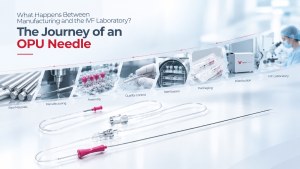




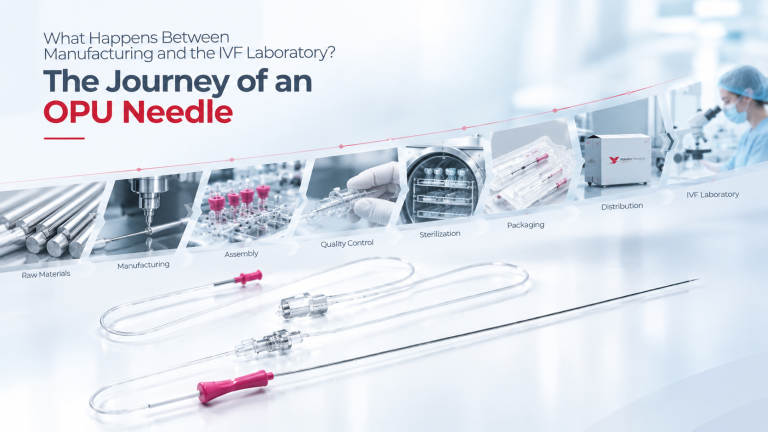
What Happens Between Manufacturing and the IVF Laboratory? The Journey of an OPU Needle
When an OPU needle reaches an IVF laboratory, it may look like a simple, ready-to-use medical device. But behind that single sterile package is a carefully controlled journey involving materials, needle manufacturing, component assembly, inspection, sterilization, packaging, and quality control.
For an IVF laboratory, the journey of an OPU needle matters because consistency and reliability begin long before the device reaches the operating room.
Understanding OPU needle manufacturing provides a different perspective on a device that plays an important role during oocyte retrieval.
Why the Journey of an OPU Needle Matters
Oocyte pick-up (OPU) is a procedure in which ovarian follicles are accessed under ultrasound guidance to aspirate follicular fluid and retrieve oocytes.
From the clinical perspective, attention naturally focuses on the procedure itself. From a manufacturer’s perspective, however, another question comes first:
How is an OPU needle manufactured to provide consistent characteristics from one device to the next?
This is where OPU needle manufacturing becomes more than simply producing a sharp needle.
The manufacturing journey involves multiple stages, and each stage can contribute to the final characteristics of the device.
From Medical-Grade Materials to Needle Manufacturing
The journey starts with carefully selected materials suitable for the intended medical-device application.
During OPU needle manufacturing, the needle component must be produced with controlled dimensions and geometry. Parameters such as the needle’s outer diameter, inner diameter, length, and tip configuration are part of the overall design.
At this stage, manufacturing consistency is important.
An OPU needle is not produced as an isolated prototype. Medical-device manufacturers must be able to produce multiple units according to defined specifications and quality requirements.
This means that OPU needle manufacturing involves repeatable production processes rather than simply creating an individual needle.
Needle Geometry and Tip Formation
The needle tip is one of the most recognizable parts of an OPU needle, but its design is only one element of the overall device.
During manufacturing, the needle geometry and tip configuration are formed according to the product design.
The objective is not simply to create a sharp tip. The complete needle geometry must correspond to the intended device specifications and manufacturing requirements.
For manufacturers, controlling the production process is therefore an important part of OPU needle manufacturing.
Consistent dimensions and controlled tip formation help ensure that finished devices remain within their defined specifications.
Connecting the Needle to the Hub
An OPU needle is more than the needle shaft itself.
The hub provides the connection between the needle and the aspiration system used during the procedure. Different hub configurations can be designed for different clinical workflows and equipment connections.
Depending on the product configuration, OPU needles may incorporate different hub designs, including:
Classic hub configurations
Luer-Lock connections
Three-way stopcock configurations
At this stage of OPU needle manufacturing, assembly and connection are important parts of the manufacturing process.
The needle, hub, and other components must function together as a complete medical device rather than as separate components.
Inspection and Quality Control
Before an OPU needle leaves the manufacturing environment, quality control plays an essential role.
Quality control in OPU needle manufacturing can involve inspection of defined product characteristics and verification that the finished device meets its established specifications.
Depending on the product and manufacturing system, inspection may address areas such as:
Dimensional characteristics
Needle and tip condition
Component assembly
Hub connection
Packaging integrity
Product identification and traceability
The purpose of these controls is to establish that the finished device conforms to its predefined requirements.
For a medical-device manufacturer, quality is therefore not a final visual check alone. It is part of a controlled manufacturing approach.
Sterilization and Packaging
After manufacturing and inspection, the OPU needle must be prepared for its intended use.
Sterilization and packaging are important parts of the journey because the device must reach the IVF laboratory in its intended sterile, protected condition.
Packaging also has a practical role. It protects the device during handling, storage, and transportation while maintaining the integrity of the sterile barrier.
For this reason, packaging should not be viewed as something separate from OPU needle manufacturing. It is part of the overall process of delivering a finished medical device.
From Manufacturer to IVF Laboratory
Once manufacturing, inspection, sterilization, and packaging have been completed, the OPU needle begins another stage of its journey.
It moves through storage, logistics, distribution, and eventually reaches an IVF laboratory or fertility clinic.
At this point, the device is no longer simply a manufactured component. It becomes part of a clinical workflow.
For IVF laboratories and distributors, this makes the manufacturer’s ability to maintain consistent production particularly relevant.
A supplier may provide one excellent sample, but a long-term medical-device relationship requires the ability to produce subsequent batches according to the same defined specifications.
Why Consistency Matters in OPU Needle Manufacturing
One of the most important differences between producing a medical device and producing a one-off prototype is repeatability.
An IVF laboratory does not purchase a single OPU needle for a single procedure. Clinics and distributors typically need products that can be supplied repeatedly and consistently.
This is why OPU needle manufacturing should be evaluated not only by the design of an individual device, but also by the manufacturer’s ability to maintain controlled production across batches.
Consistency can involve multiple aspects of the finished product, including dimensions, components, assembly, packaging, and other defined specifications.
For medical-device manufacturers, maintaining this consistency requires a structured manufacturing and quality-control approach.
Choosing an OPU Needle Supplier: What Should IVF Clinics and Distributors Consider?
When evaluating an OPU needle supplier, the product itself is only part of the decision.
IVF clinics, fertility centers, hospitals, and distributors may also want to understand the manufacturer’s approach to:
1. Product Specifications
Are the dimensions, configurations, and other product characteristics clearly defined?
2. Manufacturing Consistency
Can the manufacturer maintain consistent production across different batches?
3. Quality Control
Does the manufacturer have defined quality-control procedures for the finished device?
4. Product Configurations
Does the supplier offer configurations that can fit different clinical workflows and equipment requirements?
5. Sterility and Packaging
Are the sterilization and packaging processes appropriate for the intended medical-device application?
6. Documentation and Traceability
Can the manufacturer provide the documentation and product information required by the target market?
7. Supply Capability
Can the manufacturer support the expected quantities and future supply requirements?
These questions shift the conversation from simply asking “Which OPU needle should we buy?” to a broader question:
“Which manufacturer can consistently supply the device we need?”
From Production Line to IVF Procedure
The journey of an OPU needle does not begin when a clinician opens the package.
It begins much earlier—with product design, material selection, manufacturing processes, assembly, inspection, quality control, sterilization, packaging, and supply.
This perspective is particularly important when evaluating a medical-device manufacturer.
For IVF laboratories and distributors, the value of an OPU needle is not only in its final appearance. It also lies in the manufacturing system behind it.
At Masstec Medical, our focus as a medical-device manufacturer is to develop and manufacture products for IVF and gynecology applications with attention to product specifications, manufacturing consistency, and quality requirements.
From the manufacturing environment to the IVF laboratory, every stage contributes to the final product.
Conclusion
An OPU needle may be used for a relatively short part of an IVF procedure, but its journey from manufacturing to the IVF laboratory involves many stages.
OPU needle manufacturing includes much more than forming a needle tip. It involves controlled production, component assembly, inspection, sterilization, packaging, and the ability to maintain consistent product specifications.
For IVF clinics, fertility centers, and distributors, understanding this journey can provide a broader perspective when evaluating medical-device suppliers.
Because before an OPU needle reaches the IVF laboratory, it has already passed through a journey designed to turn a manufactured component into a ready-to-use medical device.
Frequently Asked Questions
What is OPU needle manufacturing?
OPU needle manufacturing is the controlled process of producing ovum pick-up needles for use in IVF procedures. It can involve material selection, needle forming, tip processing, assembly, inspection, sterilization, and packaging.
Why is consistency important in OPU needle manufacturing?
Consistency helps ensure that products produced across different batches remain within their defined specifications. For IVF laboratories and distributors, repeatable manufacturing is an important consideration when selecting a long-term supplier.
What components are included in an OPU needle?
An OPU needle generally includes the needle shaft and a hub or connection system. Depending on the product configuration, different hub designs may be available.
How is an OPU needle prepared for use?
After manufacturing and quality-control processes, the device can undergo sterilization and be packaged in a sterile barrier system according to the applicable product and manufacturing requirements.
What should IVF clinics consider when choosing an OPU needle supplier?
Clinics may consider product specifications, manufacturing consistency, quality-control processes, available configurations, sterility and packaging, documentation, traceability, and the manufacturer’s supply capability.