





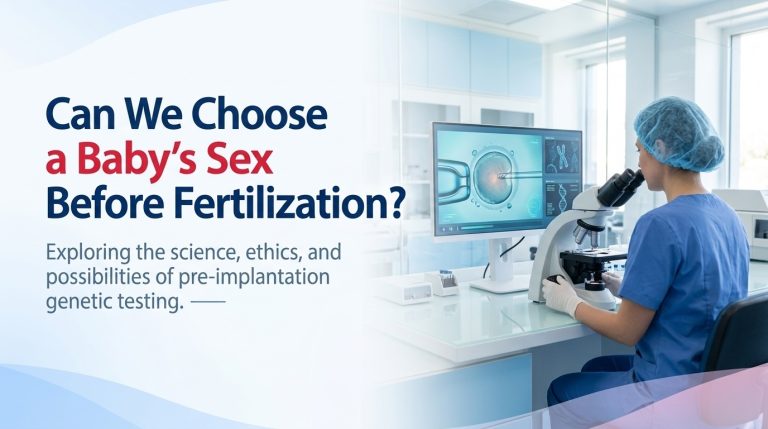
Can We Choose a Baby’s Sex Before Fertilization?
Can we choose a baby’s sex before fertilization? This is one of the most common questions people ask when they learn about IVF, ICSI, sperm selection, and preimplantation genetic testing (PGT).
The short answer is: not with conventional sperm selection or IVF alone.
Today, reproductive medicine can provide information about the chromosomal sex of an embryo after fertilization through appropriate forms of preimplantation genetic testing. Researchers have also investigated methods of separating X-bearing and Y-bearing sperm before fertilization, but these approaches are different from simply selecting an individual sperm during ICSI and do not provide the same level of certainty as testing an embryo.
So how does it actually work?
Let’s follow the process from sperm and egg to embryo.
What Determines the Sex of an Embryo?
In humans, the egg normally contributes an X chromosome, while the sperm contributes either an X or a Y chromosome.
X sperm + X egg → XX embryo
Y sperm + X egg → XY embryo
Therefore, the sperm is the source of the chromosome that determines whether an embryo is chromosomally XX or XY.
But this does not mean that a doctor can simply look at sperm under a microscope and choose an X-bearing or Y-bearing sperm with certainty.
That distinction is particularly important when discussing IVF and ICSI.
Can IVF Determine Whether the Baby Will Be a Boy or a Girl?
IVF itself does not determine the sex of the embryo.
During conventional IVF, eggs and sperm are placed together in the laboratory, allowing fertilization to occur.
The embryology team does not normally select sperm based on whether it carries an X or Y chromosome.
After fertilization, the resulting embryos continue to develop in the laboratory.
What About ICSI?
ICSI, or intracytoplasmic sperm injection, is different from conventional IVF in the way fertilization is performed.
With ICSI, an embryologist uses a specialized microscopic procedure to inject a single sperm into an egg.
This can be particularly useful in situations involving certain male-factor infertility problems or previous fertilization difficulties.
However, ICSI does not normally mean that the embryologist knows whether the selected sperm carries an X or Y chromosome.
The sperm is selected using laboratory criteria related to its appearance and suitability for injection—not by directly identifying its sex chromosome.
So:
IVF ≠ choosing XX or XY
ICSI ≠ choosing XX or XY
The method of fertilization itself does not provide reliable control over the chromosomal sex of the resulting embryo.
Can We Choose a Baby’s Sex by Selecting Sperm?
This is where the science becomes particularly interesting.
Researchers have investigated methods for separating X-bearing sperm from Y-bearing sperm before fertilization.
One of the best-studied approaches is flow-cytometric sperm sorting.
X-bearing sperm contain slightly more DNA than Y-bearing sperm. Flow cytometry can use differences in DNA content to enrich a sperm sample for X-bearing or Y-bearing sperm.
Research using this approach has demonstrated that the proportion of X- or Y-bearing sperm in a sample can be shifted significantly. In a large observational study of the MicroSort approach, samples sorted toward X-bearing sperm averaged about 87.7% X-bearing sperm, while samples sorted toward Y-bearing sperm averaged about 74.3% Y-bearing sperm. Among babies born in that study, 93.5% following X-sorting were female and 85.3% following Y-sorting were male.
These findings are important—but they also demonstrate the key limitation:
Sperm sorting enriches a population of X- or Y-bearing sperm; it does not make the result 100% certain.
Earlier clinical research similarly found that flow cytometric sorting could enrich sperm populations for X or Y chromosomes, but the resulting populations were not completely pure.
Is Sperm Sorting the Same as Choosing a Sperm During ICSI?
No.
This is an important distinction.
With ICSI, an embryologist selects one sperm cell for injection based primarily on its observable characteristics and suitability for the procedure.
With sperm sorting, the goal is different: the laboratory attempts to create a population enriched in X-bearing or Y-bearing sperm before fertilization.
Therefore, sperm sorting and ICSI should not be presented as the same technology.
What Happens After Fertilization?
Once fertilization occurs, the embryo begins a series of developmental stages.
A simplified pathway is:
Egg + sperm
↓
Fertilization
↓
Zygote
↓
Early embryo
↓
Blastocyst
At the blastocyst stage, embryo biopsy may be performed when PGT is indicated.
A small number of cells are removed from the embryo and analyzed by a specialized genetic laboratory.
Can PGT Tell Us Whether an Embryo Is XX or XY?
Yes, when the PGT approach being used includes analysis that identifies sex chromosomes.
This is fundamentally different from sperm selection.
Before fertilization:
Researchers can attempt to enrich a sperm sample for X- or Y-bearing sperm.
After fertilization:
Genetic testing can analyze cells from the embryo and identify its chromosomal profile, including XX or XY when sex chromosomes are assessed.
This is why PGT can provide information about the sex chromosome complement of embryos before embryo transfer.
The American Society for Reproductive Medicine notes that embryo sex can become known as part of PGT-A, even when the original reason for IVF was unrelated to sex selection.
Could All Five Embryos Be Girls?
Yes.
Imagine that five embryos are created during an IVF cycle.
It is possible that testing could show:
Embryo 1 — XX
Embryo 2 — XX
Embryo 3 — XX
Embryo 4 — XX
Embryo 5 — XX
It is also possible for all five to be XY, or for the group to contain a mixture of XX and XY embryos.
In a simple 50/50 probability model, having five embryos all with the same chromosomal sex is less likely than having a mixture—but it is absolutely possible.
This is one reason why the number of embryos does not automatically tell us how many will be XX or XY.
Does PGT Create the Embryo’s Sex?
No.
This is an important misconception.
PGT does not change the sex of an embryo.
The chromosomal sex was established at fertilization when the sperm contributed either an X or Y chromosome.
PGT is performed later to analyze genetic information from the embryo.
In simple terms:
Fertilization → embryo develops → biopsy → genetic testing → information about the embryo
PGT is therefore a testing technology, not a technology that changes an embryo from XX to XY or vice versa.
What Are Researchers Exploring for the Future?
Scientists continue to investigate ways of improving reproductive cell selection.
One area is advanced sperm sorting, including technologies designed to enrich sperm populations based on biological characteristics.
Another area of research involves more sophisticated laboratory analysis and automated or AI-assisted approaches to sperm assessment.
However, it is important not to confuse an emerging research technique with an established clinical method.
The history of sperm sorting shows that it is technically possible to shift the proportion of X- and Y-bearing sperm in a sample, but this is different from achieving guaranteed sex selection.
Future research may improve accuracy, efficiency, and laboratory workflows, but these technologies require appropriate clinical validation before they can be considered routine reproductive care.
IVF, ICSI, Sperm Sorting and PGT: What Is the Difference?
| Technique | Main purpose | Can it identify XX/XY embryos? | Can it guarantee embryo sex? |
|---|---|---|---|
| Conventional IVF | Fertilization | No | No |
| ICSI | Fertilization using one injected sperm | No, not by itself | No |
| Sperm sorting | Enrich X- or Y-bearing sperm populations | No embryo is tested yet | No |
| PGT | Genetic testing of embryos | Yes, when sex chromosomes are analyzed | It identifies the tested embryo’s chromosomal sex, but does not create or change it |
The important concept is that fertilization and genetic testing are two different stages of the IVF process.
Can Sex Selection Be Used for Medical Reasons?
There are situations in which embryo sex can be medically relevant.
For example, some inherited conditions are associated with the X chromosome. In such circumstances, genetic testing may be used to help identify embryos that are not affected by a particular inherited condition.
Historically, preimplantation genetic testing was developed in part to help identify embryos at risk for sex-linked genetic disorders.
This is different from choosing the sex of an embryo simply because a family prefers a boy or a girl.
Is Non-Medical Sex Selection Allowed Everywhere?
No.
Rules surrounding non-medical sex selection vary considerably between countries and jurisdictions.
Some countries restrict or prohibit non-medical sex selection, while other jurisdictions permit it under certain circumstances.
Professional organizations also distinguish between medical uses of genetic testing and sex selection for non-medical reasons. The ASRM notes that non-medical sex selection remains ethically controversial and encourages clinics to establish clear policies regarding its availability.
Therefore, patients considering this option should check the regulations of the country and fertility clinic involved.
The Bottom Line
Can we choose a baby’s sex before fertilization?
Research has shown that it is possible to enrich sperm populations for X- or Y-bearing sperm, but conventional sperm selection and ICSI do not allow an embryologist to simply choose an X or Y sperm with certainty.
The process becomes different after fertilization.
Once embryos have developed, PGT can provide genetic information about an embryo, including its sex chromosome complement when this is part of the testing performed.
So the IVF journey can be summarized as:
Egg Retrieval
↓
IVF or ICSI
↓
Embryo Development
↓
Blastocyst
↓
Embryo Biopsy
↓
PGT
↓
Genetic information about the embryo
The science of reproductive medicine continues to evolve, and sperm sorting and other emerging technologies remain areas of research. But it is essential to distinguish between what can be investigated in a laboratory, what has been demonstrated in clinical studies, and what is routinely available in fertility clinics today.
Frequently Asked Questions
Can ICSI guarantee a boy or a girl?
No. ICSI is a method of fertilization and does not, by itself, determine whether the resulting embryo will be XX or XY.
Can sperm sorting choose a boy or a girl?
Sperm sorting can enrich a sample for X- or Y-bearing sperm, but it does not provide a 100% guarantee. Clinical research has demonstrated substantial enrichment, with different levels of effectiveness for X and Y sorting.
Can PGT identify the sex of an embryo?
When the PGT analysis includes sex chromosomes, it can identify whether the tested embryo has an XX or XY chromosomal profile.
Can all embryos from one IVF cycle be girls?
Yes. It is biologically possible for all embryos in a particular group to have the same chromosomal sex.
Does PGT change the sex of an embryo?
No. PGT analyzes genetic information; it does not change the embryo’s chromosomes.
Is sex selection legal everywhere?
No. Regulations vary substantially between countries and jurisdictions, so patients should consult their fertility clinic and applicable local regulations.