





OPU Needle: How to Choose the Right Needle for Safe and Efficient Egg Retrieval
Selecting the right **OPU Needle** is one of the most important decisions for IVF clinics performing egg retrieval procedures. While physician expertise and embryology laboratory performance are critical, the design and quality of the aspiration needle also contribute to a smooth, controlled, and efficient ovum pick-up (OPU) procedure.
Modern OPU needles are designed to improve ultrasound visibility, support accurate follicle aspiration, and provide consistent handling during transvaginal egg retrieval. Understanding the key features of an OPU needle can help fertility specialists choose the most appropriate device for their clinical workflow.
Why Choosing the Right OPU Needle Matters in IVF
During egg retrieval, the physician must accurately puncture multiple ovarian follicles under continuous ultrasound guidance. The **OPU Needle** serves as the primary instrument for aspirating follicular fluid containing mature oocytes.
An appropriately designed needle can help:
- Improve procedural precision
- Support smooth follicle penetration
- Enhance ultrasound visualization
- Provide stable aspiration performance
- Increase physician confidence during egg retrieval
Although the success of IVF depends on many clinical factors, selecting a high-quality OPU needle supports a more efficient retrieval process.
Key Factors to Consider When Selecting an OPU Needle
Several characteristics should be evaluated before choosing an OPU needle for routine IVF procedures.
1-Ultrasound Visibility and Echogenicity
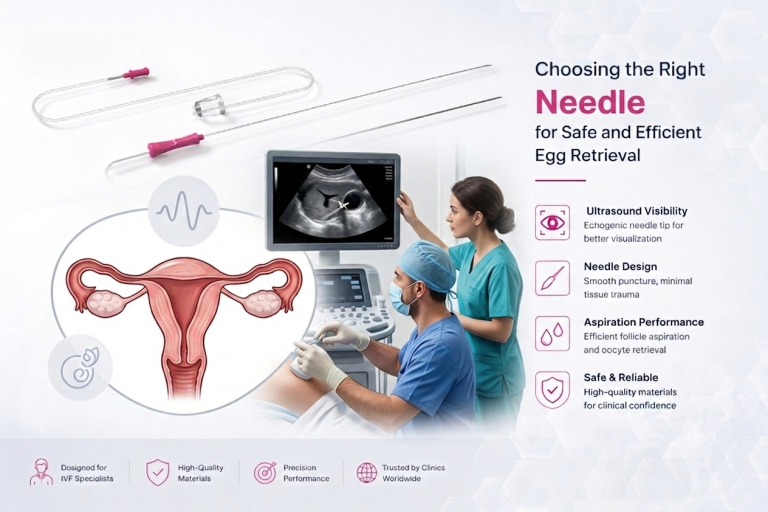
One of the most important features of an OPU needle is how clearly it appears under ultrasound.
Needles with enhanced echogenic surfaces are easier to identify during transvaginal aspiration, allowing physicians to accurately position the needle tip inside each follicle.
Improved ultrasound visibility may help:
– Increase procedural accuracy
– Reduce unnecessary needle adjustments
– Improve physician confidence
– Support efficient follicle aspiration
2-Needle Design and Tip Performance
The design of the needle tip affects how smoothly the needle penetrates ovarian tissue.
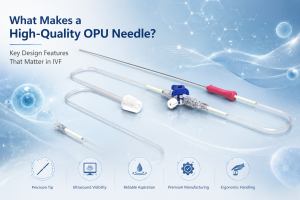
A high-quality OPU needle should provide:
– Sharp and consistent tip geometry
– Smooth penetration
– Reduced tissue resistance
– Stable handling throughout the procedure
A well-engineered tip allows controlled access to follicles while minimizing unnecessary manipulation.
3-Single-Lumen vs Double-Lumen OPU Needles
IVF clinics typically choose between single-lumen and double-lumen OPU needles depending on their treatment protocol.
Single-Lumen OPU Needles
Single-lumen needles are designed primarily for follicular aspiration.
Advantages include:
– Simple operation
– Efficient aspiration
– Shorter preparation time
– Suitable for most routine egg retrieval procedures
Double-Lumen OPU Needles
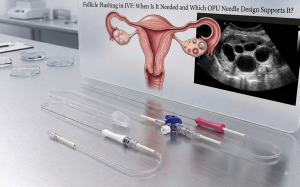
Double-lumen needles include an additional channel that allows follicular flushing after aspiration.
Potential advantages include:
– Follicular flushing capability
– Greater flexibility in selected clinical situations
– Adaptability to physician preference
The choice depends on clinic protocols rather than one design being universally superior.
4-Needle Length and Diameter Selection
OPU needles are available in different lengths and gauges.
Selection depends on factors such as:
– Patient anatomy
– Ovarian accessibility
– Physician technique
– Clinical protocol
Choosing the appropriate dimensions helps balance maneuverability, aspiration efficiency, and procedural control.
5-Aspiration Control and Handling
Reliable aspiration performance is essential during egg retrieval.
An OPU needle should provide:
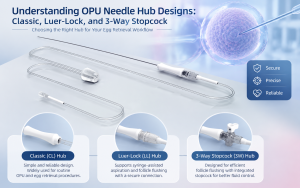
– Secure connection to the aspiration system
– Stable vacuum performance
– Comfortable handling
– Consistent fluid flow
– Reliable procedural control
Ergonomic hub design can also improve physician comfort during procedures involving multiple follicles.
6-Sterility and Manufacturing Quality
Because egg retrieval is a highly sensitive reproductive procedure, manufacturing quality is extremely important.
When evaluating an OPU needle, clinics should consider:
– Sterile packaging
– Biocompatible materials
– Consistent manufacturing standards
– Reliable quality control
– Compliance with applicable medical device standards
Consistent product quality helps support predictable clinical performance.
How OPU Needle Features Affect Egg Retrieval Performance
No single feature determines the overall performance of an OPU needle. Instead, multiple design elements work together throughout the procedure.
For example:
– Better ultrasound visibility supports precise needle positioning.
– A sharp, consistent tip allows smoother follicle penetration.
– Stable aspiration helps efficiently collect follicular fluid.
– High manufacturing quality contributes to reliable clinical performance.
The best OPU needle is one that fits the physician’s technique while supporting the IVF clinic’s overall workflow.
Choosing an OPU Needle Based on Clinic Requirements
Different IVF centers have different priorities when selecting aspiration needles.
1- Procedure Volume
High-volume clinics often prioritize:
– Product consistency
– Reliable supply
– Workflow efficiency
– Manufacturer support
2-Physician Preference
Experienced fertility specialists may prefer specific needle characteristics based on their procedural techniques.
3-Embryology Laboratory Workflow
The embryology laboratory benefits from efficient follicular fluid collection that facilitates oocyte identification and handling.
4-Patient Population
Patient anatomy and case complexity may influence the preferred needle configuration.
Common Mistakes When Selecting OPU Needles
Choosing an OPU needle should involve more than comparing prices.
Common mistakes include:
1-Choosing Based Only on Cost
A lower purchase price may not provide the best long-term value if product consistency or performance is compromised.
2-Ignoring Ultrasound Visibility
Poor needle visualization can make precise follicle aspiration more challenging.
3-Overlooking Clinic Protocols
Every IVF center follows its own clinical workflow. The ideal OPU needle should support those established procedures.
4-Not Evaluating Manufacturer Quality
Reliable manufacturers maintain consistent production standards, documentation, and quality assurance processes.
Frequently Asked Questions About OPU Needle Selection
1-What is the most important feature of an OPU needle?
Ultrasound visibility, aspiration performance, manufacturing quality, and reliable handling are among the most important characteristics.
2-Are all OPU needles the same?
No. OPU needles differ in design, echogenicity, lumen configuration, dimensions, and manufacturing quality.
3-Which is better: single-lumen or double-lumen OPU needles?
Neither is universally better. The appropriate choice depends on the clinic’s protocol and physician preference.
4-Does the OPU needle affect IVF success?
The OPU needle is one of several factors involved in egg retrieval. Clinical outcomes also depend on physician expertise, ovarian response, laboratory quality, and patient-specific factors.
—
Conclusion
Choosing the right **OPU Needle** is an important part of optimizing egg retrieval procedures. Features such as ultrasound visibility, needle design, aspiration performance, lumen configuration, and manufacturing quality all contribute to a controlled and efficient workflow.
When IVF clinics evaluate these factors alongside their clinical protocols and physician preferences, they can select an OPU needle that supports safe, reliable, and consistent egg retrieval.
For a broader overview of aspiration needle design, components, and clinical applications, read our **Complete Guide to OPU Needles in IVF**.