



What Is an OPU Needle? A Complete Guide to Ovum Pick-Up Needles in IVF
Introduction
In vitro fertilization (IVF) is a carefully coordinated process in which every step plays an important role in achieving successful outcomes. One of the earliest and most critical stages is oocyte retrieval, also known as egg retrieval, where mature eggs are collected from the ovaries before fertilization takes place.
Although this procedure is routinely performed in fertility clinics around the world, its success depends not only on the physician’s experience and ultrasound guidance but also on the quality and design of the instruments used during the procedure.
At the center of this process is the OPU needle (Ovum Pick-Up needle)—a specialized medical device designed to safely aspirate follicular fluid and retrieve oocytes with precision under ultrasound guidance.
A well-designed OPU needle helps clinicians perform controlled follicle aspiration while providing excellent ultrasound visibility, smooth penetration, and reliable handling throughout the procedure. These characteristics contribute to procedural efficiency and support consistent clinical performance in modern IVF practice.
In this article, we’ll explain what an OPU needle is, how it works during egg retrieval, the features that define a high-quality OPU needle, and what IVF professionals should consider when selecting one for clinical use.
What Is an OPU Needle?
An OPU needle, short for Ovum Pick-Up needle, is a sterile, single-use medical device specifically designed for oocyte retrieval during IVF treatment.
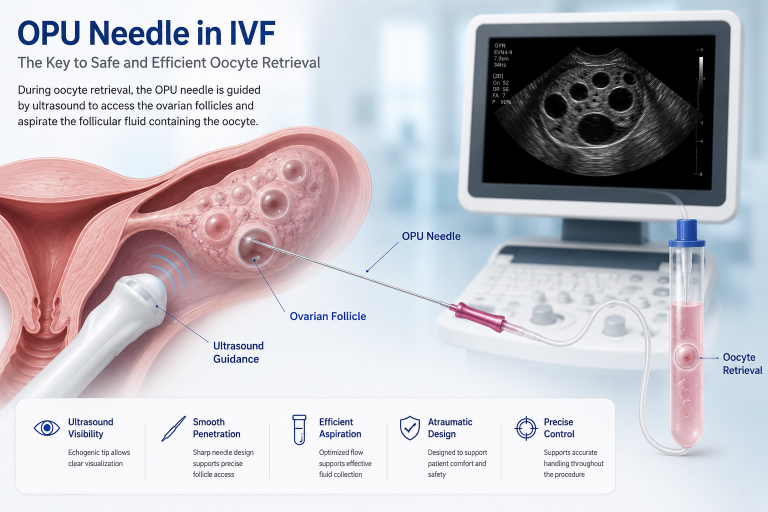
During this procedure, the physician inserts the needle through the vaginal wall under real-time ultrasound guidance to reach the ovarian follicles. Gentle suction is then applied to aspirate the follicular fluid, allowing the oocytes to be collected and transferred to the embryology laboratory for further processing.
Because the procedure requires both precision and control, the design of the OPU needle plays an important role in supporting safe and efficient egg retrieval. Factors such as needle sharpness, ultrasound visibility, handling, and aspiration performance all contribute to the overall clinical experience.
Modern OPU needles are available in different designs to meet varying clinical preferences and procedural requirements. While all are intended to retrieve oocytes, certain models may offer additional features such as different hub configurations or follicle flushing capabilities depending on the clinical protocol being followed.
As IVF technology continues to advance, OPU needles have evolved beyond simple aspiration devices into carefully engineered instruments that help clinicians perform one of the most delicate steps of assisted reproductive treatment with greater confidence.
Why Is the OPU Needle So Important in IVF?
Every IVF cycle begins with one essential goal: retrieving healthy, mature oocytes safely and efficiently.
Although embryo culture, fertilization techniques, and embryo transfer often receive the most attention, successful IVF treatment starts with high-quality oocyte retrieval. Without an effective egg retrieval procedure, the subsequent stages of IVF cannot proceed as planned.
The OPU needle serves as the primary instrument used during this stage. It allows physicians to access ovarian follicles under ultrasound guidance while minimizing unnecessary tissue trauma and maintaining precise control throughout the aspiration process.
A well-designed OPU needle can also improve procedural efficiency by providing clear ultrasound visibility, predictable handling, and smooth aspiration of follicular fluid. These characteristics help clinicians work with confidence in a procedure where precision is essential.
It’s important to recognize that IVF success depends on many factors, including ovarian response, patient characteristics, laboratory performance, and clinical expertise. However, selecting reliable medical devices remains an important part of supporting standardized, high-quality reproductive care.
For this reason, fertility clinics increasingly evaluate OPU needles not only by their basic specifications but also by their overall design, manufacturing quality, and suitability for their preferred clinical techniques.
How Does an OPU Needle Work During Egg Retrieval?
Egg retrieval is one of the most delicate stages of an IVF cycle and is typically performed under transvaginal ultrasound guidance.
Once the ovarian follicles have reached the appropriate size, the physician carefully inserts the OPU needle through the vaginal wall and advances it toward the targeted follicle while monitoring its position on the ultrasound screen.
When the needle tip reaches the follicle, gentle negative pressure is applied through the aspiration line. The follicular fluid, together with the oocyte, is then aspirated into a sterile collection tube, where embryologists immediately begin searching for the retrieved egg.
This process is repeated for each mature follicle until all suitable oocytes have been collected.
Because the needle must pass through delicate tissue while maintaining precise positioning, its design can have a significant impact on the procedure. Features such as a sharp needle tip, excellent ultrasound visibility, appropriate rigidity, and smooth aspiration help clinicians perform egg retrieval with greater confidence and consistency.
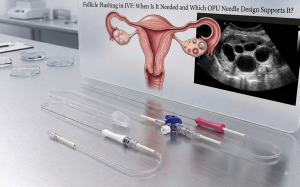
Depending on the clinical protocol, some OPU needle designs also support follicle flushing, allowing physicians to flush selected follicles after the initial aspiration when considered appropriate for the patient’s treatment plan.
What Are the Main Components of an OPU Needle?
Although an OPU needle may appear simple at first glance, it is a carefully engineered medical device made up of several components that work together during egg retrieval.
The most important component is the needle itself. It must provide sufficient sharpness for precise follicle puncture while maintaining the rigidity needed for controlled advancement under ultrasound guidance.
Another essential part is the echogenic needle tip. Enhanced ultrasound visibility allows clinicians to clearly identify the needle position throughout the procedure, supporting accurate follicle targeting and controlled aspiration.
The aspiration tubing connects the needle to the suction system, enabling smooth transfer of follicular fluid to the collection tube. Consistent fluid flow is important for efficient oocyte retrieval.
Many OPU needles also include a calibrated cannula that helps physicians estimate insertion depth more accurately during the procedure.
Finally, the hub design plays an important role in overall usability. Different hub configurations are available to support various clinical preferences and procedural techniques. Some designs focus on simplicity and cost-effectiveness, while others facilitate follicle flushing or aspiration using a syringe. We’ll explore these differences in more detail in a dedicated article about OPU needle hub designs.
Together, these components create a device that supports precision, safety, and consistent performance during one of the most important stages of IVF.
What Features Define a High-Quality OPU Needle?
Not all OPU needles offer the same level of performance. While they are designed for the same purpose, differences in engineering, materials, and manufacturing quality can influence the overall clinical experience.
One of the most important characteristics is excellent ultrasound visibility. An echogenic needle tip enables clinicians to identify the needle more easily during ultrasound-guided procedures, supporting accurate follicle targeting.
Needle sharpness is another key factor. A precisely manufactured needle facilitates smooth follicle penetration while helping clinicians maintain better procedural control.
Appropriate needle stiffness is equally important. The needle should provide sufficient support during advancement without compromising handling or precision.
Reliable aspiration performance also contributes to efficient egg retrieval. Well-designed aspiration pathways help ensure smooth follicular fluid collection throughout the procedure.
In addition, a calibrated cannula can assist physicians in monitoring insertion depth, while high manufacturing standards help deliver consistent performance from one procedure to the next.
Ultimately, a high-quality OPU needle is not defined by a single feature. Instead, it is the combination of precise engineering, reliable manufacturing, ultrasound visibility, controlled handling, and consistent aspiration performance that supports safe and efficient oocyte retrieval in modern IVF practice.
Many of these design characteristics will be explored in greater detail as part of this IVF knowledge series.
Different OPU Needle Designs for Different Clinical Needs
As IVF technology continues to evolve, OPU needles have been developed in different configurations to accommodate varying clinical preferences and procedural workflows.
While all OPU needles share the same primary purpose—retrieving oocytes safely and efficiently—they may differ in features such as hub design, aspiration options, and support for follicle flushing.
Some needle designs prioritize simplicity and ease of use for routine egg retrieval procedures. Others provide additional functionality, such as syringe-assisted aspiration or dedicated follicle flushing capabilities, allowing clinics to select a device that aligns with their preferred clinical protocol.
The choice of OPU needle is rarely based on a single feature. Instead, clinicians often consider factors such as workflow, personal experience, aspiration technique, and the specific needs of each IVF center.
Different hub configurations are designed to support different clinical techniques and procedural preferences, which we’ll explore in more detail later in this knowledge series.
How to Choose the Right OPU Needle
Selecting an OPU needle involves much more than comparing product specifications. The ideal choice should support the clinician’s preferred technique while providing consistent performance throughout the egg retrieval procedure.
When evaluating an OPU needle, IVF professionals often consider several important factors, including ultrasound visibility, needle sharpness, handling characteristics, aspiration performance, and overall manufacturing quality. Depending on the clinic’s protocol, hub configuration and follicle flushing capability may also influence the selection process.
Equally important is choosing a device that delivers consistent quality from one procedure to the next. Reliable manufacturing standards and well-designed components help create a predictable clinical experience for both physicians and embryologists.
Rather than searching for a universally “best” OPU needle, fertility clinics should identify the design that best matches their clinical workflow, patient population, and procedural preferences.
In a future article, we’ll take a closer look at the key factors IVF clinics should consider when selecting an OPU needle.
Conclusion
In this article, we’ve introduced the fundamentals of OPU needles, their role during egg retrieval, and the characteristics that distinguish modern designs.
As this knowledge series continues, we’ll explore OPU needle selection, quality features, hub configurations, and follicle flushing in greater depth to help IVF professionals better understand the factors that contribute to safe and efficient oocyte retrieval.